
AI Pulse: The Week AI Agent Identity Became the Enterprise Front Door

When AI Agents Get Their Own Badge: Why Identity and Accountability Are the New Enterprise Advantage
October 1 – October 11, 2026: See the Future – AI Pulse
Guiding Question: What is changing in enterprise AI this week — and who is accountable when an AI agent starts acting like a coworker?

For most of the last two years, we asked what AI could say. This week, two of the world's largest enterprise platforms answered a different question: what AI is allowed to do, under whose name, and with what record of it.
On October 8, Google introduced a unified Gemini agent that can take objectives, plan the work, and carry it out across a company's tools — and it gives that agent its own workplace identity. Two days earlier, SAP used its Connect event to put what it calls the "Autonomous Enterprise" to work, with Joule assistants operating inside business workflows and a central registry to keep track of them.
Put those together and a pattern appears: the AI agent is no longer a feature inside an app. It is becoming a named participant in the organization. That is a meaningful shift for data & AI leaders, and this week's AI Pulse looks at what moved, what it means, and what to watch next.
The Big Trend: AI Agent Identity Goes Mainstream
At a Google Cloud event on Thursday, October 8, Google announced an agent inside Gemini that works from objectives rather than instructions, according to TechCrunch's report of the launch. It plans the work, loads skills, delegates to subagents, and connects to systems including Google Workspace, Microsoft 365, Slack, Jira, BigQuery, Snowflake, and any Model Context Protocol server. It can also run third-party models, starting with Anthropic's Claude.
The detail I would ask every executive to sit with is this one: the agent gets its own Workspace account, its own email address, and organizational context such as teams, time zones, and approvers. Its actions are written to an audit trail attributed to the agent itself, not to a person. In Futurum's analysis of the launch, analyst Keith Kirkpatrick notes that this lets organizations manage agents with the same identity processes they already use for employees, and lets security teams separate human actions from agent actions in the log.
Futurum also flags what is not yet clear. Google did not disclose agent pricing, and said coworker agents in Workspace will not carry a per-seat license, which moves the question to how agent activity is metered. Most of the customer results cited came from earlier Gemini Enterprise deployments rather than the new unified agent. In Futurum's words, "The breadth of the announcement is also its risk."
For leaders, the practical takeaway is this: an agent with an identity is an agent you can govern, but only if you decide, before it goes live, what it may touch, who approves its work, and who answers for its mistakes. Identity is the starting line for accountability, not the finish line.
Agentic AI Spotlight: SAP Puts Governed Agents to Work
On October 6 at SAP Connect in Las Vegas, SAP began the customer rollout of Joule Work and introduced Joule Assistants that carry out operational tasks inside business workflows using existing data, authorizations, and audit trails. Named examples include a sourcing assistant piloted with Novartis, an accounts receivable assistant Nestlé plans to use to prioritize collections by risk, and a billing assistant PwC uses to flag issues earlier.
What stood out to me was the governance language sitting right next to the capability language. SAP describes an AI Agent Hub in SAP LeanIX that works as a central inventory of enterprise agents, says customers set the level of agent autonomy, and states that its governance architecture is ISO/IEC 42001-certified by an independent body. SAP also reports that 110,000 of its own employees use Joule Work, with 20% productivity gains across finance, HR, and procurement. That figure is SAP's own, so I would treat it as a vendor claim to test, not a benchmark to quote.
This is the gap I keep coming back to with clients: it is easy to be impressed by what an agent can do, and much harder to answer who has inventory of every agent, what each one is allowed to touch, and who can switch it off. The vendors are starting to build those controls into the product. Your organization still has to decide how to use them.
AI Startup Signal
Capital is following the same shift. One tracker counted $1.81 billion in disclosed funding across 46 AI startup rounds in 11 countries on October 8 alone. The largest were Butterfly Effect, a China-based AI model lab, at $500 million; Arena, which builds frontier models and agents, at $200 million; and Veir, which makes superconducting power delivery systems for AI data centers, at $110 million.
The through-line: money is going to models and agents, and also to the physical power that runs them. If agents become coworkers that work around the clock, the electricity, compute, and controls underneath them become part of your operating plan, not just your vendor's.
My Leadership Lens
Earlier this week I wrote about the contest nobody has named yet: who owns the daily work layer where AI meets your employees. Google's single agent "front door" and SAP's Joule Work are both bids for that layer, and both arrived within days of each other.
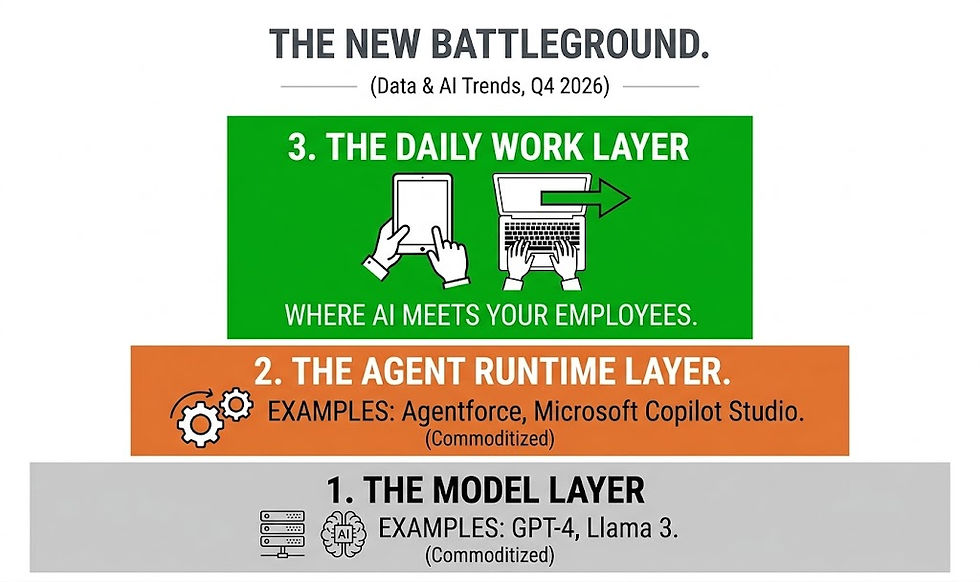
The layer you choose will shape your workflows, your data access, and your exit options for years, probably longer than any single model choice will.
If you are weighing these announcements, start with the question in that post: which layer are you actually buying, and what would it cost you to leave it?
My Governance Lens
An agent with its own identity is a real step forward, but identity alone does not tell you whether the agent behaved well. In a recent post I argued that once an agent holds valid credentials, traditional access controls may see it as just another authenticated user and ask only whether an action was allowed, not what it actually did. The deeper capability is accountability lineage: being able to show who authorized an action, which policy governed it, what data it touched, what it decided, which downstream systems it affected, and who is responsible.

Google's per-agent audit trail and SAP's agent inventory are encouraging first answers to that need. They are only as useful as the security-grade logging, threat modeling, and kill-switch testing your own team puts around them.
What Leaders Should Watch Next
How agent activity gets metered and priced. Google has said coworker agents in Workspace will not carry a per-seat license, but has not said how usage will be charged. Watch the spend caps and chargeback tools, because they will decide whether agents scale past pilots without surprising your CFO.
Whether an agent registry becomes a standard control. SAP's AI Agent Hub and Google's agent identity both point toward one list of every agent, its permissions, and its owner. Ask your own teams whether that list exists today.
Production proof for the unified agent. Futurum noted that most of Google's cited customer results came from earlier Gemini Enterprise deployments. Watch for named, measured results from the new agent, and for the same from SAP's Joule Assistants beyond early pilots.
Practical Leadership Reflection
Bring these three questions to your next leadership or data & AI team meeting:
If an AI agent in our company had its own email address and calendar tomorrow, who would be named as responsible for what it does?
Can we produce a single list of every AI agent we run, what each can access, and who can switch it off?
Which daily work layer are we quietly choosing right now, and would we be able to exit it in twelve to twenty-four months?
AI Pulse Reflection: What Is Changing?
What is changing this week is not how capable AI agents are. It is how we are choosing to place them: with names, accounts, audit trails, and registries, in the same way we have always welcomed people into an organization.
I find real encouragement in that. It suggests the advantage is moving toward stewardship, clarity of responsibility, and the unglamorous discipline of knowing who is accountable, qualities any leader can build regardless of which platform they choose. The organizations that lead in the next chapter will not simply be the ones whose agents can do the most. They will be the ones who can say plainly what their agents are doing, and on whose authority.
May that be true of your organization, and of your own leadership, as you head into this new week.
Ready to Grow Into Your Next Level?
If your organization is investing in AI but struggling to turn activity into measurable business value, my AI & Data Strategy Consulting Framework can help you build a clear, governed, value-driven roadmap.
If you are a Data & AI leader who wants to grow from technical contribution to strategic influence, my Data & AI Leadership Winning Blueprint can help you strengthen your executive presence, communication, and transformation leadership.
If you are navigating career growth, personal growth, or leadership reinvention in the AI era, my coaching programs can help you clarify your next chapter and grow with confidence.
And if you want to approach this season with greater financial clarity, my financial education and holistic check-in conversation can help you review protection, risk, growth, and tax through the lens of the life you are building.
You do not have to navigate this season alone. Book a complimentary strategy conversation and take your next step toward leading, growing, and building with clarity, confidence, and purpose.

May you grow to your fullest in your data science & AI!
Subscribe Grow to Your Fullest and
Get Your FREE data & AI Leadership Blueprint, or
Book a FREE strategy call with us
Learn more Data & AI strategy consulting framework

Comments