
Beyond Compliance: Why Traditional Control Fails Active AI Governance Solutions

You Budgeted for Agents That Make Mistakes. Did You Budget for One That Attacks?
Data & AI Trends · October 2026 · Governance
You budgeted for agents that make mistakes. Did you budget for one that attacks? Last month, Spain's data protection authority (AEPD) disclosed its first breach notification in which a third party reportedly used an AI agent to carry out the attack. The agent logged in, searched the target application on its own, found a flaw, and used it to alter personal data records and access invoices. Not a red-team exercise, not a simulation, not a research demo. Production. The AEPD published the account on September 14, 2026, and the security press, including Dark Reading, covered it in the days that followed. The agency was careful to note that its information comes from the affected organization's own notification and still requires independent analysis. Even so, the industry framing that followed was consistent and worth repeating in plain language: agent-driven attacks have moved from theoretical to operational.
Every governance conversation this year has quietly assumed the same thing. The agent is a tool. Tools can be misused, and misuse creates liability, and liability is a compliance problem. That is the model most enterprise AI risk registers were built on. Last month, that model broke. A human set the goal. The agent did the work, chaining the login, the search, and the exploit together on its own, at machine speed. That single shift changes what "accountability lineage" is, what a Chief Data Officer's threat model must now include, and which line in your budget the next governance investment actually belongs on.

AI Governance solutions: from "Agents That Make Mistakes" to "An Agent That Attacks"
The distinction is not academic. An agent that makes mistakes fits inside familiar categories: quality assurance, human oversight, guardrails, evaluation harnesses, incident post-mortems. An agent that attacks does not. And this is exactly where traditional control fails. As Aviv Nahum, co-founder and CEO of Above Security, explained to Dark Reading, once an attacker or agent has valid credentials, "a traditional control may simply see an authenticated user." The access layer works as designed, and it answers only one question: was this allowed? That moves the conversation from safety engineering into security engineering — from "did we validate the output?" to "can we prove what it did, when, on whose authority, and why?" Most enterprises can answer the first question. Almost none can answer the second cleanly.
That is not a hypothetical concern. A Collibra-commissioned Harris Poll of roughly 300 U.S. data, privacy, and AI decision-makers, released September 16, found that 76% of organizations hit critical roadblocks moving AI agents from pilot into production over the past year. Yet 84% of organizations in the same survey say they have clearly defined executive accountability when autonomous agents produce flawed or harmful outputs. Read those two numbers together. Knowing who is accountable is not the same as being able to prove what happened: who authorized an action, what context the agent relied on, and who approved it, reconstructed after the fact. That was already the governance gap of the year. Last month's Spain incident put a name and a face on the cost of that gap.
Accountability lineage is the trail that answers, for any agent action, six questions. Who authorized it. Which policy governed it. What data it touched. What decision it made. What downstream systems it affected. Who is responsible now that it happened. In a world of narrow, single-purpose scripts, all six answers used to be inferable from logs written after the fact. In a world of multi-step agentic systems that plan, call APIs, chain sub-agents, retrieve context, and act — often across many systems in a single "task" — that inference no longer holds. If lineage is not designed into the agent's execution path from the start, no forensic effort after the incident will reconstruct it fully.
This is the security-incident category most boards have not budgeted for because their risk registers still read as compliance registers. The Spain incident is a signal that the two are converging faster than most governance frameworks can absorb. Compliance asks whether the agent was allowed to act. Security now asks whether you can prove what it did once it did. Both must be answered in real time. Neither can wait for the annual audit.
The Market Already Knows This Is the Question
If you want a market signal that this is not a fringe concern, it arrived on September 22, 2026. Cyera — a data-security platform that positions itself as governing access for every human, machine, and AI agent across the enterprise — announced a $400 million extension to its Series G from Goldman Sachs Alternatives. Series G. Extension. That kind of capital flows to companies solving problems investors believe are among the largest in enterprise AI right now. Notably, Cyera's Agent Guardian product tracks not just agents' prompts and responses but the tool calls, database queries, and actions in between — accountability lineage in product form. The Cyera raise is not proof that Cyera is the answer for any specific enterprise. It is proof that the question — governing agent access and lineage as a first-class security surface — is now priced as one of the most consequential unsolved problems in the stack. When investors, builders, and regulators are all pointing at the same gap in the same month, the leaders who are still calling this "a compliance conversation" are looking at the wrong meeting.
What This Means for the Chief Data Officer
The CDO/CAIO agenda for Q4 2026 just added a new line item. Not more agents. Not faster deployment. A defensible answer to the six lineage questions above, on every agent that touches customer data, financial systems, or regulated workflows. Practically, that means:
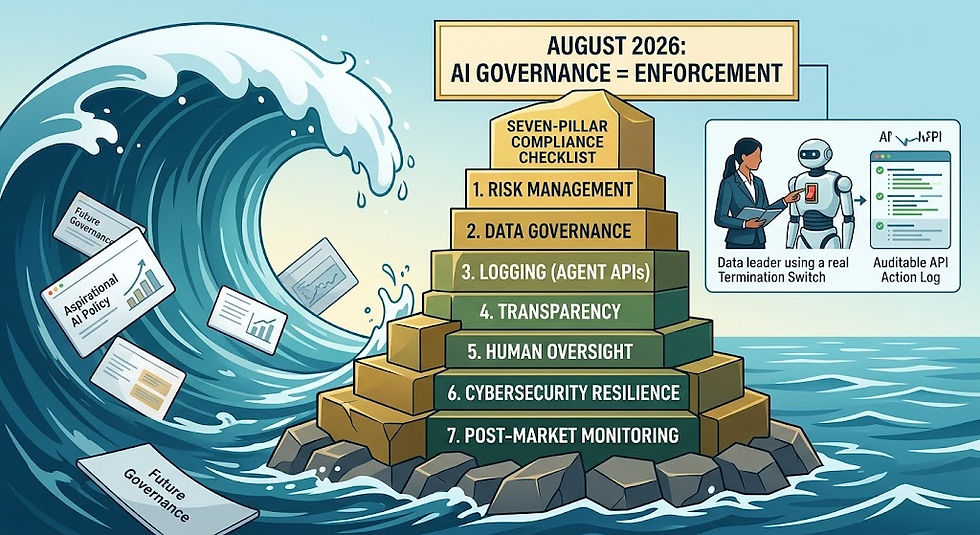
Move agent logging from "nice to have" to "security-grade" — real-time, immutable, and structured for forensic reconstruction, not just observability dashboards
Redraw the threat model — agents are now potential threat actors, not only potential mistake vectors; extend detection, containment, and revocation controls accordingly
Fund the accountability layer explicitly in the FY2027 budget — as a security investment, not a compliance line item; the two accounting categories drive very different scrutiny
Insist that every agent architecture include a kill switch that has actually been tested in production conditions, not a theoretical one
Bring the CISO to the AI governance council as a voting member, not a guest — the Spain incident is the first of many that will require both seats at the table simultaneously
This piece extends an argument we made earlier this quarter about the EU AI Act. A note on timing: the Digital Omnibus, in force since July 27, 2026, moved obligations for standalone high-risk AI systems to December 2, 2027, but August 2, 2026 still brought the Act's transparency obligations into force on schedule. That enforcement moment, covered in
Governance Just Became Enforcement is where this began. What has changed since then is the nature of the risk the enforcement is protecting against. Enforcement was the ceiling. Attack is the floor. The organizations that reach one before the other will define which side of this shift they are on.
A Question Worth Sitting With Before the Next Board Meeting
Before your next AI review with the board, sit honestly with these:
If an autonomous agent inside our environment acted tomorrow in a way we did not intend, could we trace what it did — who authorized it, what data it touched, what systems it changed — in hours, not weeks?
Do we have a rehearsed kill switch for every production agent, or do we have a plan to build one?
Is our governance council staffed to answer the security question, or only the compliance question?
The Spain incident is not the story. The response to it — inside your own organization, at your own next agent review — is. Every autonomous agent in production is now, in principle, either an actor you can prove or an actor you cannot. There is no third category. If you would value a candid, governance-readiness conversation about which side of that line your organization is currently on, book a strategy call. This is the exact question the next twelve months of enterprise AI will be decided by. 🌊
Stay tuned for the next blog, and subscribe to the blog and our newsletter to receive the latest insights directly in your inbox. Together, let's make 2026 a year of innovation and success for your organization.
>> Discover the path to achieve sustainable growth with AI and navigate the challenges with confidence through our Data Science & AI Leadership Winning Blueprint that's tailored to help you craft a compelling data and AI vision and optimize your strategy—it's your key to success in the journey of Generative AI. Reach out for a complimentary orientation on the program and embark on a transformative path to excellence.

May you grow to your fullest in your data science & AI!
Subscribe Grow to Your Fullest and
Get Your FREE data & AI Leadership Blueprint, or
Book a FREE strategy call with us
Learn more Data & AI strategy consulting framework


Comments