
AI Pulse: The Week AI Infrastructure Investment Overtook the Model Race

From Smartest Model to Best-Funded Data Center: Why the Money Moved to Infrastructure
August 31 – September 6, 2026: See the Future – AI Pulse
Guiding Question: What is changing in enterprise AI this week — and what does it mean for how you invest and lead?

This week, two very different data points told the same story. Anthropic signed a $35 billion cloud deal for a single Texas data center. And a fresh global survey found that while more enterprises than ever say they’re “scaling” AI agents, financial returns are still trailing enthusiasm by a wide margin.
Put those together, and a pattern emerges: the AI race is no longer about who has the smartest model. It’s about who can actually build, fund, and operationalize the infrastructure and discipline to put AI to work at scale.
For data & AI leaders, that’s a meaningful shift in where to focus. This week’s AI Pulse looks at what moved, what it means, and what to watch next.
The Big Trend: AI Infrastructure Investment This Week
On Monday, August 31, Anthropic signed a $35 billion cloud computing deal with Nvidia-backed Lambda, securing AI computing capacity at a data center campus under development in Nueces County, Texas.
The scale is notable on its own. But the timing matters more. This deal landed the same week Microsoft and HUMAIN expanded their strategic collaboration at LEAP 2026, introducing a new enterprise AI productivity bundle and confirming enterprise availability of the HUMAIN AI PC beginning September 20.
Two of the industry’s largest players, in the same week, made their biggest moves not around a new model release, but around the infrastructure and packaging needed to actually deliver AI at enterprise scale. That is worth sitting with.
For leaders, the practical takeaway is this: your AI budget conversation this quarter should include infrastructure, data residency, and deployment capacity — not just which model to license.
Agentic AI Spotlight
Agentic AI adoption numbers keep climbing — and so does the gap between adoption and results. McKinsey’s newly released State of AI: Global Survey 2026 found that 40 percent of organizations with more than $1 billion in annual revenue now say they’re scaling AI agents, up from 27 percent a year ago.
But scaling and succeeding are not the same thing. McKinsey’s own data shows that in any single business function, no more than 10 percent of organizations are actually scaling agents — and while 80 percent of respondents report individual productivity gains, only 37 percent report measurable financial impact at the organizational level. Just 6 percent qualify as “AI high performers,” attributing at least 5 percent of EBIT to AI.
This is the gap I keep coming back to with clients: enthusiasm for agents is real and growing. Operational readiness — governance, evaluation, data quality, change management — is what’s actually gating results. If your organization is excited about agents but hasn’t built the muscle to evaluate, govern, and support them in production, this is the week to name that gap out loud.
Industry Transformation & AI Tools
The Microsoft-HUMAIN expansion is also a preview of where enterprise AI packaging is heading. HUMAIN ONE with Microsoft 365 Copilot bundles an agentic AI layer directly into everyday productivity tools, giving employees one interface to interact with enterprise applications, data, and workflows — rather than a separate AI tool bolted onto existing systems.
Watch for more of this pattern: AI capability arriving pre-integrated into the tools your teams already use, rather than as a new platform to evaluate and roll out separately. That lowers the adoption barrier — but it also means governance and data-access decisions are being made earlier and faster than many organizations are ready for.
AI Startup Signal
Venture capital isn’t slowing down either. AI-related startups raised roughly $9.2 billion across 46 disclosed rounds between August 31 and September 6 alone.
Notable rounds this week: Shield AI raised a reported $1.5 billion for autonomous defense systems, legal-AI platform Legora raised $550 million, and Nexthop AI raised $500 million to address networking constraints created by AI workloads. Even General Intuition’s $320 million round — training agents on video-game data to teach real-world actions in simulation first — signals investors betting on the unglamorous infrastructure layers beneath agent capability, not just the agents themselves.
The through-line across all of it: money is following the same signal enterprises are — infrastructure, reliability, and deployment readiness, not just model capability.
My Leadership Lens
I wrote about this exact shift earlier this month, watching model prices fall and access become commoditized while a dozen serious models landed within weeks. When access to strong models becomes cheap and common, the competitive advantage moves elsewhere — to workflow design, data readiness, and how well an organization can actually operationalize what a model can do:

This week’s infrastructure deals are the next chapter of that same story. If the model is no longer the moat, infrastructure and execution discipline are becoming the new one. As a leader, the question isn’t “which model should we use” nearly as much as it is “do we have the infrastructure, data pipelines, and organizational readiness to put any model to work reliably.” That’s a harder, less glamorous question — and it’s the one worth asking in your next AI budget review.
My Governance Lens
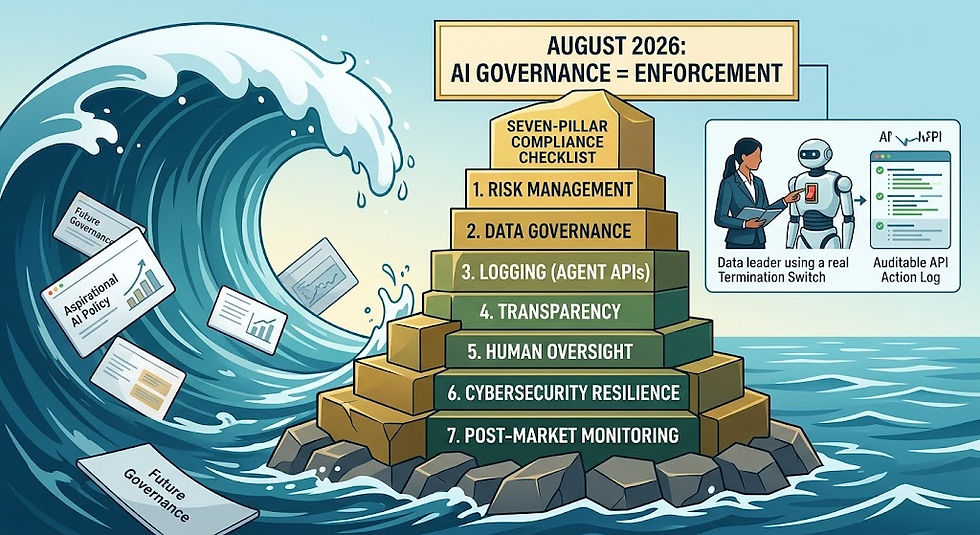
As infrastructure investment accelerates and agentic AI layers get bundled directly into everyday tools, governance can’t stay a step behind. Earlier this month I wrote about the EU AI Act’s high-risk enforcement deadline and what it means that agent action layers are now squarely in scope — not just the models generating recommendations, but the agents actually taking action on an organization’s behalf:
That distinction matters more this week, not less. When AI capability arrives pre-bundled into tools your teams already use — as it is with the new HUMAIN ONE and Microsoft 365 Copilot offering — the governance conversation has to happen before rollout, not after adoption is already underway. Faster deployment without faster governance is not a shortcut. It’s a debt you’ll pay later, usually at a worse time and a higher cost.
What Leaders Should Watch Next
Infrastructure and compute commitments from major AI labs and cloud providers — these signal where the next 12–18 months of enterprise AI capacity, pricing, and capability will actually come from.
The agent adoption-to-ROI gap — watch whether the “scaling agents” number keeps climbing while the financial-impact number stays flat. That gap is where governance failures and disillusionment both tend to start.
Pre-bundled AI capability inside tools you already use — as more vendors follow Microsoft and HUMAIN’s lead, the “should we adopt this AI tool” decision will increasingly get made for you by default settings.
Practical Leadership Reflection
Bring these three questions to your next leadership or data & AI team conversation:
Where in our AI budget are we still funding model experimentation when the real gap is infrastructure, data readiness, or deployment capacity?
If an AI agent layer got bundled into a tool our team already uses tomorrow, do we have a governance process ready — or would we find out after the fact?
Which of our current AI pilots are we genuinely on a path to scale, and which are we scaling in name only, without the operational readiness behind them?
AI Pulse Reflection: What Is Changing?
What’s changing this week isn’t the pace of AI progress — that’s been relentless for over a year now. What’s changing is where the smart money and the smart questions are landing: not on which model wins, but on who has built the infrastructure, governance, and organizational readiness to actually use what’s available.
I find real encouragement in that shift. It means the advantage is moving toward discipline, stewardship, and preparation — qualities that any leader can build, regardless of which model or vendor they choose. The organizations that will lead in the next chapter of AI won’t necessarily be the ones with access to the newest model. They’ll be the ones who did the unglamorous infrastructure and governance work first.
May that be true of your organization — and of your own leadership — as you head into this new week.
Ready to Grow Into Your Next Level?
If your organization is investing in AI but struggling to turn activity into measurable business value, my AI & Data Strategy Consulting Framework can help you build a clear, governed, value-driven roadmap.
If you are a Data & AI leader who wants to grow from technical contribution to strategic influence, my Data & AI Leadership Winning Blueprint can help you strengthen your executive presence, communication, and transformation leadership.
If you are navigating career growth, personal growth, or leadership reinvention in the AI era, my coaching programs can help you clarify your next chapter and grow with confidence.
And if you want to approach this season with greater financial clarity, my financial education and holistic check-in conversation can help you review protection, risk, growth, and tax through the lens of the life you are building.
You do not have to navigate this season alone. Book a complimentary strategy conversation and take your next step toward leading, growing, and building with clarity, confidence, and purpose.

May you grow to your fullest in your data science & AI!
Subscribe Grow to Your Fullest and
Get Your FREE data & AI Leadership Blueprint, or
Book a FREE strategy call with us
Learn more Data & AI strategy consulting framework

Comments