
The Contest Nobody Named Just Started: Who Owns the Daily Work Layer Where AI Meets Your Employees

The Model Layer Commoditized. The Agent Runtime Just Commoditized. The Next Contest Is Not for Either.
Data & AI Trends · October 2026
The model layer already commoditized. The agent runtime just commoditized. The next contest — and it started this month — is not for either. It is for the daily work layer where AI actually meets your employees. That is what Dreamforce 2026 was really about. That is what Microsoft's newly disclosed $2.5 billion, 6,000-engineer enterprise services unit is really funding. And that is what a small South Korean startup filing patents on agentic document-reading tells you the market has quietly agreed on: the platform battle has moved up the stack, and the layer being fought over now is the interface where the AI meets the person.
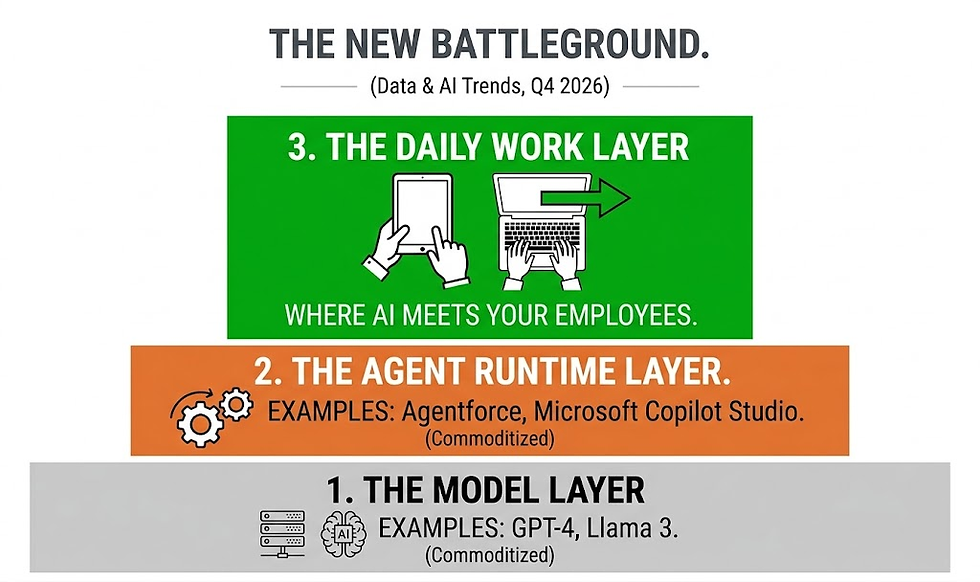
Every enterprise AI conversation for the last two years has been about capability. What is the model? What is the runtime? What is the benchmark? Those questions still matter. But they no longer decide the contest. The contest is now about whose interface sits between your employee and every model, every agent, every workflow they touch — and about who quietly owns the loyalty, the data flow, and the switching cost that comes with owning it.
What Actually Happened at Dreamforce
Salesforce unveiled two things worth naming in plain language. The first is AIforce — a new interface layer positioned as "the" front door for AI-augmented work across the Salesforce estate. The second is Headless 360 — a composable architecture that lets Salesforce's data, workflows, and controls be pulled into other surfaces without demanding those surfaces sit inside Salesforce's UI. Together they are being framed as an Enterprise AI Harness. The framing is not accidental. "Harness" is the word for the layer that constrains and directs an animal that would otherwise wander. Salesforce is telling the market that in the next chapter of enterprise AI, whoever owns the harness owns the animal, and whoever owns the animal owns the daily work of the company.
Read past the marketing language and the strategy is legible. Salesforce is not competing on the model. It is not competing on the agent runtime. It is competing to be the harness that decides which model, which agent, which workflow gets to touch its customers' data and its customers' employees. If it wins that layer, the underlying models and runtimes become interchangeable — and that is not a bug in the strategy. That is the strategy.
What Microsoft's $2.5 Billion Bet Confirms
The Microsoft signal from the same window is quieter and, in some ways, more decisive. A newly disclosed $2.5 billion unit with 6,000 engineers, dedicated to working directly with enterprise clients as they design and run AI systems. That is not a product bet. That is a services bet — and the size of it tells you what Microsoft believes. It believes that in the next twelve to twenty-four months, the buying decision that matters most is not "which model?" or "which runtime?" It is "who is standing next to us, inside our environment, as we wire this into the way our people actually work?" The 6,000 engineers are the answer. So is the price tag.
Salesforce is racing to own the interface. Microsoft is racing to own the implementation. Different plays, same underlying bet. The interface layer and the implementation layer are both, in different ways, the daily work layer. Whichever vendor sits in that layer — via UI, via services, or via both — sits in the seat where enterprise AI actually gets used or ignored.
The 42Maru Signal (Why the Small Story Matters)
One more data point worth naming, and it is not from a hyperscaler. In the same window, South Korean startup 42Maru filed patents for agentic AI technology that reads a company's unstructured documents and generates the requested information as tables and charts. Read as an isolated announcement, it is one more agent story in a year full of them. Read as a signal, it is more consequential. The patent filings are staking territory in exactly the same layer Salesforce and Microsoft are chasing — the layer where a human asks a question in plain language and gets back structured, decision-ready output from the company's own data. Startups do not file patents in a layer they think is uncontested. The patent filings are, quietly, a statement that this is the layer the next round of platform value will be captured in — and everyone who is paying attention knows it.
Why This Is a Different Contest Than the Model War
It is worth being precise about what has changed. In 2024 and most of 2025, the enterprise AI question was "which model?" In the first half of 2026, it was "which runtime?" In September and October 2026, it has become "which daily work layer?" Each of those questions has a different set of contestants, a different set of switching costs, and a different set of implications for the buyer.
Model choice used to lock enterprises in for years. It no longer does. Runtime choice used to lock enterprises in for quarters. It increasingly does not. Daily work layer choice — the interface, the harness, the services partner sitting between the model and the person — locks enterprises in for decades, because it captures the workflow, the data flow, the muscle memory, and the trust of the workforce that has been trained to use it. The vendors who understand this are moving accordingly. The vendors who do not are still selling models and runtimes into a market that has quietly stopped optimizing for either.
What This Means for Data & AI Leaders
Five moves worth carrying into Q4:
Name the layer you are actually buying — not "AI capability," but which of the three (model, runtime, daily work layer) each vendor is competing to lock you into
Recognize that a daily work layer decision, once made, is a much longer commitment than a model or runtime decision — price the exit before you sign the entry
Ask, honestly, whether your organization's own "daily work layer" is being designed by you or by the vendor whose UI your employees are learning fastest
Reserve the interface layer for a deliberate portfolio decision — not for the vendor that happens to bundle it into an existing contract
Fund the internal capability — data, governance, workflow design — that makes any daily work layer valuable, because that is the part no vendor can sell you
A Question Before Q4 Closes
Before the next vendor conversation, sit honestly with these:
If our employees were asked, quietly, whose interface they open first when they need an AI answer — is that the vendor we chose, or the vendor that quietly chose us?
How much of what we currently classify as "model spend" is really daily-work-layer spend that we have not yet named as such?
If we had to migrate off our current AI daily work layer in eighteen months, how many years of workflow, muscle memory, and workforce training would we be walking away from?
The model war is not over, but it has moved. The agent runtime war is not over either, but it has moved too. The contest that decides the next decade of enterprise AI is being fought at the layer where the person and the machine actually meet — and it started this month, whether the vendor conversations you are already in have named it yet or not. The leaders who will look back on Q4 2026 well are the ones who see the layer they are actually choosing, and choose it on purpose. If a candid conversation about your own daily-work-layer strategy would be useful before the year closes,
a short strategy call is one place to start. The contest is not going to wait for the naming. 🌊
Stay tuned for the next blog, and subscribe to the blog and our newsletter to receive the latest insights directly in your inbox. Together, let's make 2026 a year of innovation and success for your organization.
>> Discover the path to achieve sustainable growth with AI and navigate the challenges with confidence through our Data Science & AI Leadership Winning Blueprint that's tailored to help you craft a compelling data and AI vision and optimize your strategy—it's your key to success in the journey of Generative AI. Reach out for a complimentary orientation on the program and embark on a transformative path to excellence.

May you grow to your fullest in your data science & AI!
Subscribe Grow to Your Fullest and
Get Your FREE data & AI Leadership Blueprint, or
Book a FREE strategy call with us
Learn more Data & AI strategy consulting framework


Comments