
If AI Development Itself Is Accelerating, What Should You Be Learning Right Now? A Case for Durable AI Judgment Over Tool Fluency

tool-specific fluency has a six-month half-life. durable AI judgment compounds.
AiFullest · November 2026 · Durable AI Judgment
If AI development itself is accelerating — not just the capabilities inside the tools, but the pace at which the tools themselves are being rewritten — what should you actually be learning this quarter? The answer most career coaches give is wrong, and the two biggest AI stories of this week make the mistake visible. Anthropic's November 2 SEC filing warned that future models may imminently cross an internal threshold its own policy defines as dramatically accelerated progress. Goldman Sachs, in the same week, restricted Claude Code and GitHub Copilot to its roughly 12,000 engineers — removing those tools from the traders and bankers who had been using them for months. Both stories point at the same shift. The skill worth building now is not deeper fluency with any specific AI tool. The tools are rewriting themselves too fast for fluency to compound. The skill worth building now is durable AI judgment — the ability to catch what the tool got wrong, to decide what should not be delegated, and to work alongside a capability that is changing underneath you.

For every data and AI leader thinking about their own next twelve months — their next promotion, their next role, their next contribution — this is the strategic question hiding inside this week's news. If you spend the next twelve months getting faster at today's AI tools, you will have a resume filled with half-life-six-months skills. If you spend the next twelve months building durable AI judgment, you will have a career that compounds even as the tools underneath it keep changing.
What Durable AI Judgment Actually Means
Durable AI judgment is not a mystical quality. It is a specific, teachable skill set, and it has four components that each build on real work:
The ability to catch what plausible-looking AI output is likely to be wrong, specifically. Not line-by-line proofreading. Pattern-reading. Asking the three questions nobody prompted: what edge case did it skip, what assumption did it bake in, what will this do under conditions it did not see in training.
The ability to decide what should not be delegated. Not every task should be done by an agent, even when it technically can be. Judgment about which decisions belong to a human, which require human review of AI output, and which can run autonomously is now one of the most valuable scarce skills in enterprise AI.
The ability to explain AI output in the language the business needs. A model's output is raw material. Translating it into the specific business decision a leader is being asked to make — in their language, at their cadence — is a learned skill. The AI does not do that translation. People do.
The ability to work alongside a capability that is changing underneath you. The AI capability landscape in January 2027 will not be the one in September 2026. Working productively inside that acceleration — knowing what to re-evaluate each quarter, when to retire an old workflow, when to adopt a new one — is itself a skill.
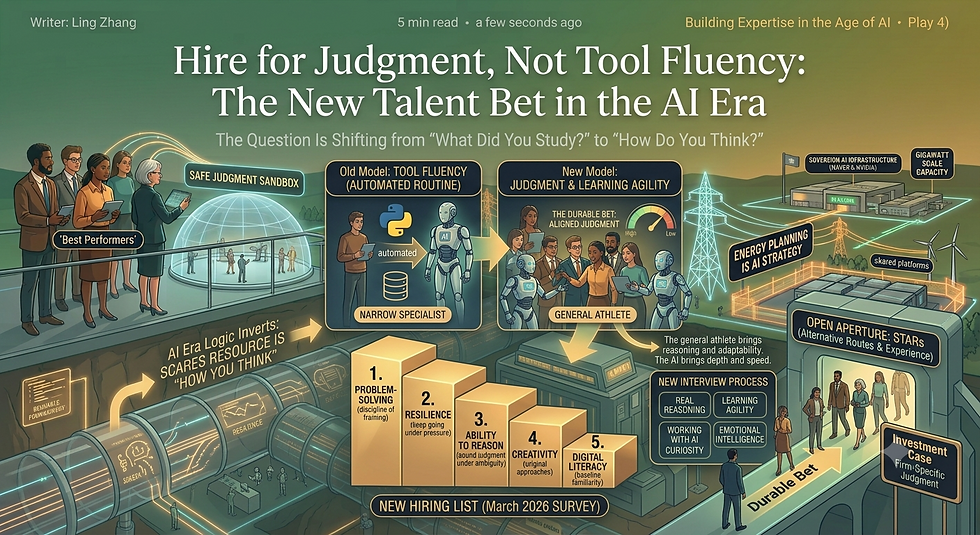
The context on how this specific skill set is already reshaping engineering hiring — an 81% production-incident rate on AI-coded work that nobody is formally crediting — lives in AI Code Review: The Skill That Just Got More Valuable in the Age of AI-Written Software. The adjacent hiring-side evidence is in Hire for Judgment, Not Tool Fluency: The New Talent Bet in the AI Era.
Why the Goldman Sachs Signal Proves the Point
Goldman Sachs restricting Claude Code and GitHub Copilot to its engineers — stripping access from traders and bankers who had been using them — is not a failure of AI adoption. It is a specific institutional signal about what durable AI judgment looks like in a regulated environment. Four months ago, non-engineers were allowed to vibe-code prototypes because the enterprise valued speed of experimentation over the governance cost. This month, the same enterprise decided the governance cost of production-grade AI tooling in non-engineer hands is higher than the experimentation value.
The traders and bankers who lose access are not punished. The enterprise is naming a line between where this tooling belongs and where it does not. For every individual leader watching this, the career lesson is sharp. The ones who spent four months getting faster at Claude Code will discover their tool-specific fluency does not carry the status it did in July. The ones who spent four months learning to judge AI output — when to accept it, when to refuse it, when to escalate it — have skills that transfer to whatever tool the enterprise authorizes next. Tool fluency depreciates. Durable AI judgment compounds.
What to Invest In Over the Next Twelve Months — Three Specific Practices
Three practices separate the leaders who will come out of 2027 stronger from the ones who will be scrambling:
Build a personal case library of AI errors you caught. Not vague "I noticed the model was wrong" stories. Specific, documented examples — the prompt, the output, the error, the fix, the business consequence of catching it. Ten of these in twelve months is a portable, promotable artifact that survives any specific tool change.
Make one deliberate delegation decision per month and write down your reasoning. What did you choose to let an AI do fully, what did you choose to keep as human-in-the-loop, what did you choose not to delegate at all, and why? Twelve decisions in twelve months is the beginning of a defensible judgment framework.
Pair with someone outside your technical specialty — a business leader, a legal counsel, a customer-facing manager — on how to translate AI output into their decision context. Not a tutorial. A real translation task, done monthly. The leaders who can translate AI output into other people's decisions are the leaders every executive table needs.
The Shelf Life of Tool Fluency vs. the Compounding Returns of Judgment
The honest frame is this. A specific tool you learn deeply today will, if frontier capability continues to accelerate the way Anthropic's filing suggests it may, be functionally different in nine months. Not because you failed to keep up. Because the underlying model changed, the interface changed, the workflow around it changed. Your tool-specific expertise has a short half-life regardless of your effort.
Durable AI judgment — the ability to catch errors, make delegation calls, translate AI output into decisions, and work productively inside acceleration — does not depreciate. It compounds. A leader who has been building this judgment for twelve months is more valuable at month twelve than at month six, and more valuable at month twenty-four than at twelve, specifically because the terrain has kept changing underneath them. That is the asymmetric investment thesis for every AI leader's own career right now.
A Question Worth Sitting With Before Your Next Career Review
Before your next performance review, promotion case, or private weekend planning session:
If I built my own twelve-month career plan around durable AI judgment rather than tool-specific fluency, which of the three practices above am I actually doing today — and which is the one I would start on Monday?
Of my last twenty AI-assisted tasks, how many errors did I catch that the AI missed, and could I describe five of them specifically enough to include in a portfolio? If not, what would I have to start recording on Monday?
If the specific tools I know best are rewritten or replaced in the next nine months, what in my judgment framework survives — and what was tool fluency I did not realize I was accumulating as a depreciating asset?
The AI capability landscape is not going to stop changing on your schedule. It will change on its own. The leaders who treat the acceleration as a reason to build deeper tool fluency are investing in an asset with a shrinking half-life. The leaders who treat it as a reason to build durable AI judgment are investing in an asset that compounds. If you would value a candid conversation about what your own twelve-month skill investment should actually look like, book a strategy call. The tools will keep rewriting themselves. The judgment compounds. 🌊
Stay tuned for the next blog, and subscribe to the blog and our newsletter to receive the latest insights directly in your inbox. Together, let's make 2026 a year of innovation and success for your organization.
>> Discover the path to achieve sustainable growth with AI and navigate the challenges with confidence through our Data Science & AI Leadership Winning Blueprint that's tailored to help you craft a compelling data and AI vision and optimize your strategy—it's your key to success in the journey of Generative AI. Reach out for a complimentary orientation on the program and embark on a transformative path to excellence.

May you grow to your fullest in your data science & AI!
Subscribe Grow to Your Fullest and
Get Your FREE data & AI Leadership Blueprint, or
Book a FREE strategy call with us
Learn more Data & AI strategy consulting framework


Comments