
Hire for Judgment, Not Tool Fluency: The New Talent Bet in the AI Era

The Question Is Shifting from "What Did You Study?" to "How Do You Think?"
Building Expertise in the Age of AI (4)
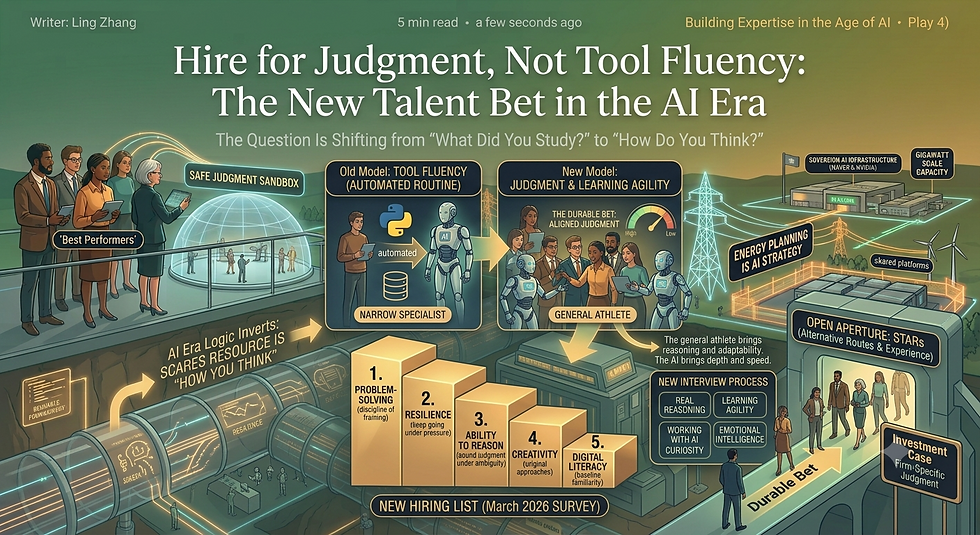
For most of the last generation, hiring for entry-level roles rewarded deep specialization early. Pick the right major, get the right internship, master the right tool, and the pipeline would carry you forward. In the AI era, that logic quietly inverts. As AI and knowledge systems increasingly provide on-demand expertise, the scarce resource is no longer what you know—it is how you think. That is why McKinsey's Play 4 in Building expertise in the age of AI (Hancock & Seiler, July 2026) reframes the entire hiring conversation: hire for judgment, not tool fluency. The durable bet on entry-level talent is the general athlete, not the narrow specialist.
The organizations moving fastest have already made this shift. They are recruiting for adaptability over narrow expertise, for cognitive range over resume checklists, for how a candidate learns and reasons rather than what they happened to have studied. In an AI-augmented workflow, that turns out to be the trait that predicts long-term contribution best.
Why Tool Fluency Is No Longer Enough
Tool fluency was once a durable advantage. If you were the fastest in Excel, the sharpest in Python, the most fluent in SQL, you had leverage others didn't. AI has made those baseline capabilities cheap and universal. The junior employee with only tool fluency now competes directly with an agent that has more of it, works faster, and never sleeps. What the agent cannot yet do—reason across an ambiguous situation, connect distant signals, decide when to trust the model and when to override it—is precisely where human value now concentrates. Tool fluency is table stakes. Judgment is the differentiator.
The Skills at the Top of the New Hiring List
In a March 2026 survey of roughly 1,500 executives and senior talent leaders, employers rated the skills that matter most for entry-level hires. When you look at the top of the list, a pattern is unmistakable: alongside digital literacy, they prioritize the qualities associated with high general cognitive ability:
Creativity — the capacity to generate original approaches when the playbook runs out
Problem-solving — the discipline of framing problems well before rushing to answers
Resilience — the ability to keep going when feedback is hard and progress is invisible
Ability to reason — sound judgment under ambiguity, incomplete data, and time pressure
Research reinforces this pattern: roles that demand AI skills are also nearly twice as likely to demand analytical thinking, resilience, or agility alongside them. The complementary human skills rise as AI itself rises. Hiring managers who see this early gain a real edge.
The "General Athlete" Hire
One head of HR at a Fortune 100 financial firm described the new profile bluntly: not a specific degree, but a "general athlete" with strong learning instincts, relational skills, and baseline familiarity with AI. The image is exact. A general athlete can move across positions, adapt to new plays, and elevate whichever team they are on. In an AI-augmented workflow, that ability to move is more valuable than any single technical specialty. The general athlete brings the reasoning and adaptability. The AI brings the depth and speed. Together they outperform either alone.
Widening the Aperture: STARs and Non-Traditional Talent
This shift also opens the front door wider. It welcomes what the nonprofit Opportunity@Work calls STARs—Skilled Through Alternative Routes—individuals without four-year degrees who have built real capabilities through experience. When AI provides on-demand access to knowledge, the traditional gate of formal credentialing loses some of its usefulness. What matters more is whether the candidate can reason, learn, and apply. STARs, with the right support and development, can contribute meaningfully far earlier than traditional models assumed. For organizations, this is not just an equity story. It is a talent-pool expansion at exactly the moment specialization is losing its premium.
Firm-Specific Judgment: Why This Is Not Generic Training
A common objection to hiring for judgment sounds reasonable: if we invest in early-career general athletes, won't our competitors just poach them? The article's answer is quietly powerful. Judgment built on a firm's own codified expertise (Play 1), practiced through its answer-key model (Play 2), and formed in the flow of its actual work (Play 3) is partly firm specific. It travels less easily than a certification. The general athlete you develop into a judgment-carrying leader is more yours than any specialist who could relocate their skill set overnight. The investment protects itself over time, because the depth is contextual.
What the Interview Now Needs to Actually Test
If judgment is the durable bet, the interview process has to measure something other than tool tests. That means:
Real reasoning under ambiguity — cases without a single right answer, judged on how the candidate frames and defends
Learning agility — not what they know, but how quickly they update in response to new information
Working with, not around, AI — put an AI tool in front of them and watch when they trust it, when they push back, and how they explain the difference
Emotional intelligence and relational skills — because juniors will now engage senior stakeholders far earlier than before
Curiosity as a discipline — the questions they ask are often more diagnostic than the answers they give
What This Means for Data & AI Leaders
Concretely:
Rewrite entry-level job descriptions around adaptability, reasoning, and learning instinct—not narrow specialization
Open the aperture to STARs and other high-potential candidates without traditional four-year credentials
Redesign interviews to test judgment under ambiguity and reasoning with AI in the loop, not tool fluency alone
Anchor the case for investment in the firm-specific nature of the judgment your system will build
Coach hiring managers explicitly on the shift from "what did they do?" to "how do they think?"
A Moment of Reflection
Before your next round of hiring:
Would our current interview process actually detect the general athlete—or filter them out for lacking a specialist resume?
Are we still rewarding candidates for what AI can now do, instead of what only humans still can?
Whose judgment, five years from now, do we most need to be growing—and are we hiring for that today?
The AI era does not make people less important. It clarifies which people matter most. In a world where knowledge and tools are increasingly on demand, the durable advantage flows to those who can think—and to the organizations wise enough to hire and grow them. The question at the front door has quietly changed. The winners are the ones already asking it. 🌊
In Play 5, we complete the framework with the layer that ties everything together: the preceptor model of manager coaching, and why upskilling managers to teach judgment may be the most underinvested move in AI adoption.
Stay tuned for the next blog, and subscribe to the blog and our newsletter to receive the latest insights directly in your inbox. Together, let's make 2026 a year of innovation and success for your organization.
>> Discover the path to achieve sustainable growth with AI and navigate the challenges with confidence through our Data Science & AI Leadership Winning Blueprint that's tailored to help you craft a compelling data and AI vision and optimize your strategy—it's your key to success in the journey of Generative AI. Reach out for a complimentary orientation on the program and embark on a transformative path to excellence.

May you grow to your fullest in your data science & AI!
Subscribe Grow to Your Fullest and
Get Your FREE data & AI Leadership Blueprint, or
Book a FREE strategy call with us
Learn more Data & AI strategy consulting framework


Comments