
AI Code Review: The Skill That Just Got More Valuable in the Age of AI-Written Software

Eighty-One Percent Shipped an AI-Coding Incident. Nobody Is Measuring It.
AI Impacts on Workforce · October 2026 · AI Code Review
Eighty-one percent of senior engineering leaders had an AI-coding incident reach production in the last six months. Ninety-three percent said a hallucination sent their team chasing the wrong root cause. The LeadDev / Undo survey of 300 senior engineering leaders across the US and UK, published October 12, 2026, is the first large study to put numbers on something most leaders have been quietly absorbing: the AI-productivity story has an unmeasured cost side. Teams are reporting velocity gains while a debugging tax nobody is tracking lands on the same people, every sprint, in the margins of their day.

Speed is not the whole ledger. It never was. It is the number everyone reports, and the number that hides the one that matters. The real AI leadership question is not how fast your team ships. It is what you actually know about what shipped — and who on the team can tell.
Why AI Code Review Just Became the Most Valuable Engineering Skill
For most of the last decade, the career-making skill in software engineering was speed to a working first draft. Write the code, pass the tests, ship. AI compressed that part of the job to minutes. The first draft is no longer the signal. What catches attention — in a pull request, in a postmortem, in a promotion packet — is now what nobody taught explicitly for years: the ability to look at a plausible-looking output and know, specifically, what might be wrong with it before anyone else does.
That is AI code review in its modern form. Not line-by-line proofreading. Judgment under ambiguity. The developer who can read AI-generated code and ask the three questions nobody prompted — "what edge case did it skip," "what assumption did it bake in," "what will this do under load" — is the developer whose team ships fewer incidents. The 81% number says most teams do not have enough of these people yet, and most of the ones they do have are not being formally credited for the work.
The Debugging Tax Nobody Is Tracking
Ninety-three percent of surveyed leaders said at least one AI hallucination sent their team chasing the wrong root cause. That is not a tooling problem. That is time, cognition, and morale leaving the team through a door that is not on any dashboard. The organizations that have gotten this measurement right — and there are not many yet — are the ones that have added three metrics to their engineering review cycle:
Mean time to detect an AI-introduced error, not just mean time to resolve it.
Ratio of incidents where the first-pass root cause was wrong because of AI-generated misdirection.
Hours per sprint spent reviewing or correcting AI-generated code, by individual, not by team.
None of these show up on a standard velocity dashboard. All of them show up on the P&L. The connection between measurement discipline and real AI ROI is covered in
The AI Harness Layer: Why Scaling AI Was Never the Hard Part — Proving AI ROI Is — this piece is the engineering-floor view of the same gap.
What to Hire For, What to Promote For
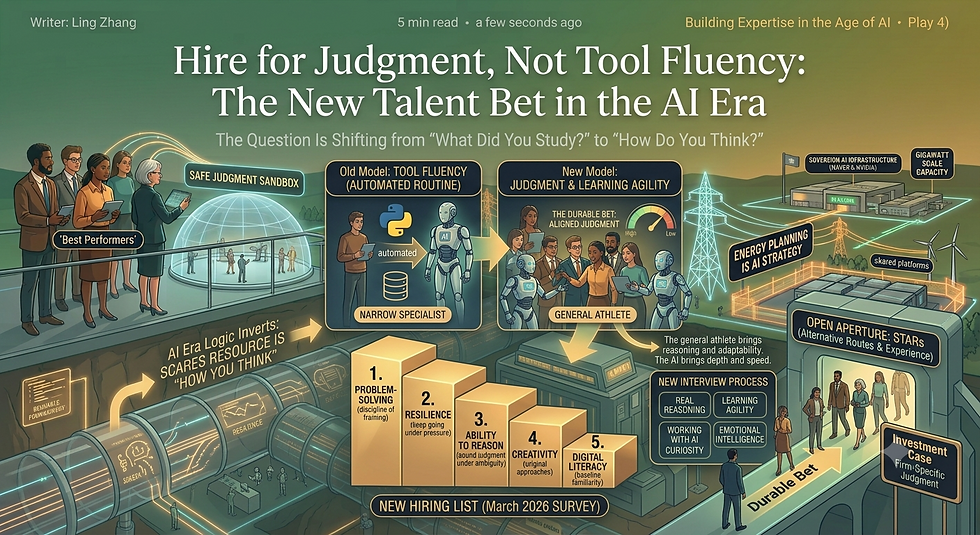
The organizations hiring well three years from now are not the ones with the hardest take-home tests. They are the ones who have redesigned what they are testing for. The companion piece on how that evaluation shift plays out in interviews is
Hire for Judgment, Not Tool Fluency: The New Talent Bet in the AI Era, and the broader evaluation-signal crisis — why proxy work has gotten noisier for every discipline — is in The AI Skills Evaluation Crisis.
Three practices separate the teams that get this right from the ones who find out the hard way:
Promote the person who catches the AI error, not just the person who ships the AI-assisted feature. Make catching errors a line in the career ladder, not a thing that happens in review as a favor.
In interviews, use a thirty-minute working session where the candidate uses AI openly on a real problem from your business. Watch what they do not trust the tool to do. That tells you more than any take-home.
Make the postmortem the status meeting. Not the sprint demo. The team that reviews its AI-driven incidents in public is the team that stops repeating them.
The Career Signal AI Code Review Sends
For engineers earlier in career, the implication is simpler and sharper than most leaders are naming out loud. The way to get noticed on a team shipping AI-generated code is not to be faster. It is to be the one who catches what everyone else missed. The AI code review skill — the specific judgment of what plausible-looking output is likely to be wrong — is now the clearest line on a promotable resume in engineering. Learn it in public. Practice it in code review conversations. Volunteer for the root-cause investigation nobody wants to run. That is the career signal that compounds.
A Question Worth Sitting With Before the Next Sprint Review
Before your next engineering review, sit honestly with these:
Of the AI-coding incidents our team shipped in the last ninety days, do we know how long it took to catch each one — and who, specifically, caught it?
Does our career ladder reward judgment on AI-generated code the way it rewards speed to a first draft?
If the person on our team with the sharpest AI code review instincts left tomorrow, could we name three people who would absorb that work — or would we not notice until the incident count climbed?
The AI-productivity story has a cost side. The teams that measure it, build the skill around it, and promote the people who hold that skill will be the ones compounding advantage three years from now. If you would value a candid conversation about where your engineering organization is on this exact question, book a strategy call. The debugging tax does not stay hidden forever — the organizations that find it first get to decide what to do about it. 🌊
Stay tuned for the next blog, and subscribe to the blog and our newsletter to receive the latest insights directly in your inbox. Together, let's make 2026 a year of innovation and success for your organization.
>> Discover the path to achieve sustainable growth with AI and navigate the challenges with confidence through our Data Science & AI Leadership Winning Blueprint that's tailored to help you craft a compelling data and AI vision and optimize your strategy—it's your key to success in the journey of Generative AI. Reach out for a complimentary orientation on the program and embark on a transformative path to excellence.

May you grow to your fullest in your data science & AI!
Subscribe Grow to Your Fullest and
Get Your FREE data & AI Leadership Blueprint, or
Book a FREE strategy call with us
Learn more Data & AI strategy consulting framework


Comments