
The AI Skills Evaluation Crisis: Why 60% of Hiring Managers Say Real Skills Have Gotten Harder to Evaluate

Six in Ten Hiring Managers Say Real Skills Just Got Harder to Evaluate.
AI Workforce Transformation · October 2026 · AI Skills Evaluation
Sixty percent of US hiring professionals now say AI has made it harder to evaluate whether a candidate actually has the skills they claim. That is the headline figure from the Workforce Decoded Report Western Governors University released on September 30, 2026, surveying 3,128 US hiring professionals. The AI skills evaluation gap is not just a hiring frustration — it is already shaping which doors open and close. Among employers who say AI has made real skills harder to evaluate, 54% report that AI has reduced entry-level hiring at their organization, compared with 20% among the rest. The door to the first job is closing faster where trust in the evaluation signal is thinnest.

The share of employers still figuring out how to evaluate AI skills effectively has roughly doubled year over year — from 16% in 2025 to 32% in 2026. The doubling is not the story on its own. The second-order consequence is: when the evaluation tool stops working, the rational short-term response is to hire people who have already been evaluated somewhere else. That means fewer first jobs. Which means fewer people getting evaluated at all. Which closes the door further next year. This is a leadership decision, and nobody is calling it one yet.
What Actually Broke in AI Skills Evaluation
For most of the last fifty years, the signal an employer used to evaluate an entry-level candidate was proxy work: the portfolio, the take-home, the coding exercise, the writing sample, the case study, the internship output. Those signals worked because the cost of producing them was roughly proportional to the skill required. That proportion is now much weaker. A candidate using a frontier model can produce a portfolio piece that is difficult to distinguish at first read from the work of someone three years into the discipline. The signal did not disappear — it got noisier. Hiring managers are not confused. They are correctly observing that their evaluation tools no longer measure what they were designed to measure.
Why "Test Harder" Is Not the Answer
The reflex most hiring teams reach for first is the testing arms race: harder take-homes, in-person coding, proctored assessments, more interview rounds. It is a losing position. The models improve faster than the tests. Every additional friction costs more candidates than it filters — disproportionately costing the candidates most organizations say they want to hire. The organizations hiring well three years from now are not the ones with the hardest tests. They are the ones who redesigned what they are testing for. The role redesign framework behind this shift lives in
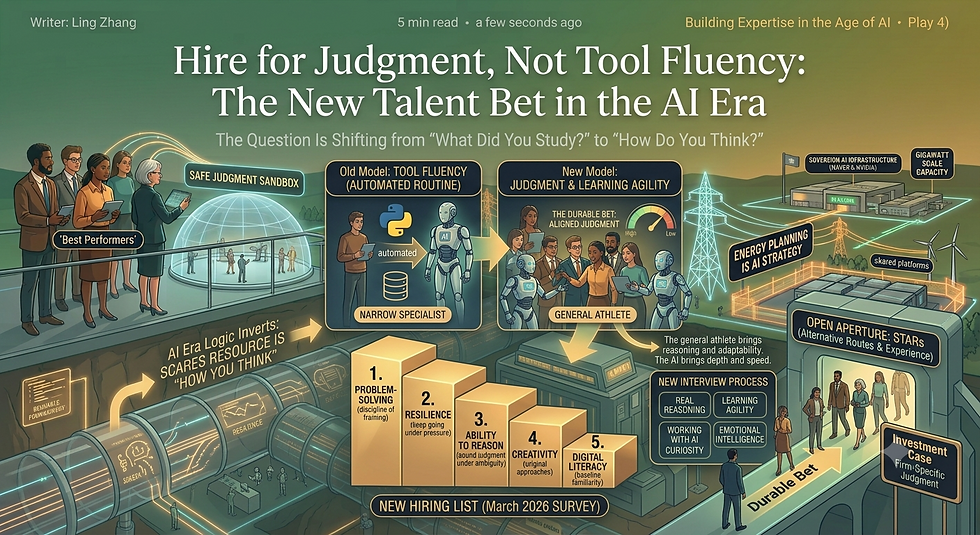
The Answer-Key Model: Redesigning Entry-Level Roles for the AI Era, and the evaluation shift is in Hire for Judgment, Not Tool Fluency.
What AI Skills Evaluation Should Actually Measure
The skills AI has not replaced — the ones no first-draft output can fake — are the ones that show up when the plan contacts reality:
Judgment under ambiguity — can the candidate decide what not to do? AI will give a competent answer to a bad question. A person who can tell the difference is the signal worth hiring on.
Working with the model, not against it — how do they use the tool, where do they not trust it, how do they catch it when it is wrong. The best entry-level candidates talk about this with the comfort an experienced engineer talks about code review.
Communication under revision — not the first draft, the second one, after a stakeholder has pushed back.
Taste — the ability to look at an AI-generated output and say what is wrong, specifically, in context. The single hardest capability to fake and the one that most strongly predicts year-two usefulness.
None of these show up on a take-home. All of them show up in a thirty-minute, well-run conversation.
The Leadership Decision Nobody Is Naming
If 54% of employers struggling with evaluation have already cut entry-level hiring and the trend holds, the US workforce is running an uncontrolled experiment: what happens when a cohort struggles to get a first job? Three years out: a thinner mid-career pipeline, a widening gap between the credentialed-and-connected and everyone else, and — for the employers running the experiment — a bench noticeably thinner than it needed to be. The organizations fine in that future are the ones that redesigned entry-level work this year. Not eliminated it. Redesigned it. Fewer entry-level roles, each one real. Scoped so the person is accountable for a decision, not a task. Paired with a senior mentor whose job is coaching judgment. The retention angle to this redesign — and why the most AI-fluent employees also become the most likely to leave — is covered in
A Question Worth Sitting With Before the Next Board Meeting
Before your next workforce or hiring review, sit honestly with these:
What would our interview look like if we assumed, from the first question, that the candidate is using the same AI tools we do — and the question is no longer whether, but how well?
Of the last ten entry-level rejections, can we articulate specifically what made each a "no" — or are we rejecting on signals that AI has made meaningfully noisier?
If we protected two entry-level roles this year — real roles, real scope, real mentorship — what would it take, and what would we need to see in twelve months to know the redesign worked?
Sixty percent of hiring managers say the signal just got harder to read. The organizations that respond by closing the door are solving the wrong problem. The organizations that redesign the door are the ones who will have a bench three years from now. If you would value a candid conversation about what the first-job redesign looks like in your organization, book a strategy call. This is the exact question the next twelve months of workforce leadership will be decided by. 🌊
Stay tuned for the next blog, and subscribe to the blog and our newsletter to receive the latest insights directly in your inbox. Together, let's make 2026 a year of innovation and success for your organization.
>> Discover the path to achieve sustainable growth with AI and navigate the challenges with confidence through our Data Science & AI Leadership Winning Blueprint that's tailored to help you craft a compelling data and AI vision and optimize your strategy—it's your key to success in the journey of Generative AI. Reach out for a complimentary orientation on the program and embark on a transformative path to excellence.

May you grow to your fullest in your data science & AI!
Subscribe Grow to Your Fullest and
Get Your FREE data & AI Leadership Blueprint, or
Book a FREE strategy call with us
Learn more Data & AI strategy consulting framework


Comments