
The New CAIO Mandate: Owning Both Innovation and Enforcement in the Post-EU AI Act World

Two Jobs, One Seat: Why the Post-August CAIO Now Owns Innovation and Enforcement at the Same Time
Data & AI Leadership · September 2026 · Week 2
For most of the last two years, the Chief AI Officer role was defined almost entirely by one word: innovation. Find the use cases. Pick the models. Ship the pilots. Prove the value. That version of the job was already demanding. As of August 2026, it is also insufficient. The EU AI Act's high-risk enforcement deadline landed on August 2, backed by fines of up to €35 million or 7% of global turnover. The U.S. Commerce Department set national security review gates for frontier models. NIST is publishing an AI Agent Interoperability Profile by year-end. Practically overnight, the CAIO's job description added a second half — one most incumbents were not hired for and most organizations have not yet fully staffed.
Welcome to the new CAIO mandate: innovation and enforcement, running side by side in the same seat. Whoever holds that seat in September 2026 is now expected to compress two very different jobs into one — and the leaders who navigate this shift well will define the next decade of enterprise AI.

The Old Job: Ship the Use Case
The original CAIO job was fundamentally optimistic. Identify high-value opportunities. Build cross-functional coalitions. Pick technologies. Move pilots into production. Show ROI. Those responsibilities have not gone away — if anything, model commoditization (with GPT-5.6 Luna prices dropping 80% and a dozen serious models released in August alone) makes shipping use cases faster and cheaper than ever. What has changed is that shipping is no longer the whole job.
The New Job: Prove You Can Control What You Shipped
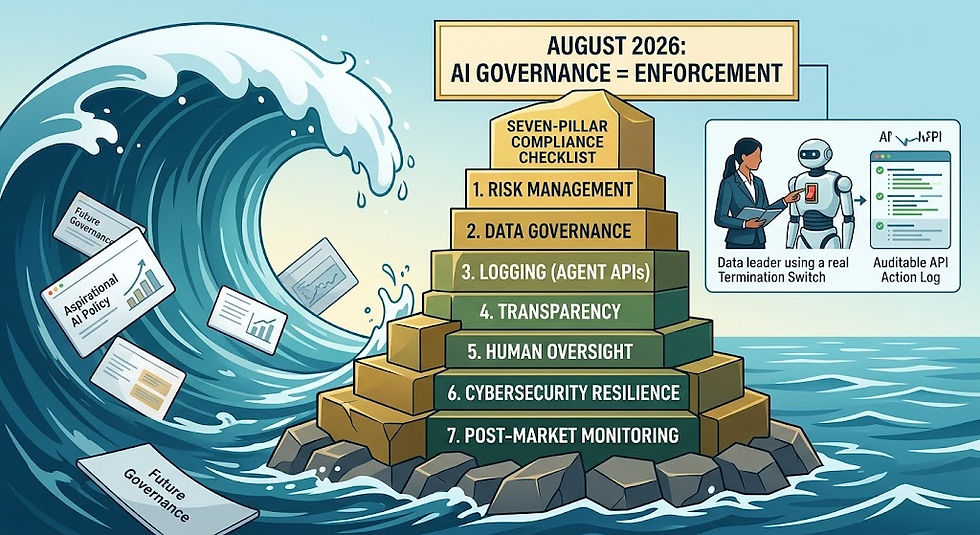
The second half of the CAIO job — the one that arrived with August's enforcement wave — is defensive and continuous. Not just "can we build this?" but "can we prove, at any moment, that we are controlling it responsibly?" Under the EU AI Act's high-risk provisions, the answer must live in a documented, ongoing system, not a launch checklist. The CAIO now owns risk management, data governance, logging, transparency, human oversight, cybersecurity resilience, and post-market monitoring — for every AI system the enterprise deploys — as a continuous obligation. That is a fundamentally different discipline than shipping.
Why This Cannot Be Delegated to Legal or Compliance Alone
The instinct in many enterprises will be to move governance into the general counsel's office or the CISO's team and let the CAIO focus on innovation. That instinct is understandable and dangerously incomplete. The problem is that AI governance requires deep understanding of how models actually behave, where hallucinations creep in, how agents chain calls to APIs, and where a small change to a prompt library ripples through the enforcement surface. Legal alone cannot see that. Security alone cannot see that. Only the CAIO — or a CAIO working in true partnership with legal, security, and compliance — has both the technical fluency and the operational reach to build governance that actually holds.
The Agentic Compliance Surface Just Doubled
There is one more force compressing the two halves of the job. In August, the EU AI Act made explicit that AI agents invoking APIs — including internal services, third-party platforms, and MCP servers — bring that action layer into scope under cybersecurity and logging mandates. In multi-agent architectures, every agent performing a high-risk function is part of the compliance boundary. That means the same agentic AI capability that the CAIO is being asked to scale is simultaneously the biggest source of new regulatory exposure. Innovation and enforcement are not separate initiatives. They are two views of the same system.
What the New CAIO Operating Model Looks Like
The best CAIOs are already rewiring the role. Practical patterns emerging in September 2026:
Two-track roadmap — every AI initiative is planned with an innovation track and an enforcement track, funded and staffed from day one, not bolted on later
Joint governance council — the CAIO chairs a standing council with CISO, general counsel, chief compliance officer, and CHRO; agenda covers use cases, agent controls, and audit posture in the same meeting
Living controls, not documents — policies become code (guardrails, evaluation harnesses, kill switches, logging) so compliance can move at the speed of deployment
Portfolio-level risk view — AI use cases are managed as a portfolio with explicit risk tiers, not as a set of independent projects
Board-quality reporting — the CAIO produces a quarterly AI posture report the audit committee can actually use
Hire for Judgment at the Top, Too
The hiring implications are direct. The next generation of CAIOs will need not just technical fluency and business fluency, but a third leg: regulatory fluency. Boards should stop looking for candidates who are strong in one of the three and hope the other two show up. The role now demands a leader comfortable talking about vector databases with engineers, about EBITDA with the CFO, and about Article 15 obligations with the general counsel — often in the same day. That leader is rare. Building the internal bench that can grow into it may be the single most important talent investment enterprises make in the next 18 months.
What This Means for Data & AI Leaders
Five moves for Week 2 of September:
Explicitly redefine the CAIO role (or its equivalent) to include innovation AND enforcement — write it into the charter, not just the calendar
Stand up (or upgrade) a joint governance council chaired by the CAIO; put use cases and controls on the same agenda
Move policies to code — guardrails, evaluation harnesses, agent kill switches, and continuous logging as engineering deliverables
Build a portfolio-level view of AI risk, tiered by EU AI Act criteria, not by project size
Start growing the next CAIO from a pool that combines engineering depth, business acumen, and regulatory fluency
A Moment of Reflection
Sit with these:
Does our CAIO have both the mandate and the resources to run innovation and enforcement — or are we quietly asking them to do enforcement in their spare time?
If a regulator arrived tomorrow, could our AI leader show a continuous, documented governance system — not a slide deck?
Who inside our organization is being developed to hold this seat five years from now?
The August 2, 2026 deadline did not create the CAIO role. It expanded it, permanently. The leaders who compress innovation and enforcement into a single, coherent operating discipline will build durable enterprise AI capability. The ones who treat governance as a legal problem will keep shipping — until the day they can't. The best Chief AI Officer of 2027 will look very different from the one hired in 2024. September is the month to start hiring, developing, and empowering that person. 🌊
Stay tuned for the next blog, and subscribe to the blog and our newsletter to receive the latest insights directly in your inbox. Together, let's make 2026 a year of innovation and success for your organization.
>> Discover the path to achieve sustainable growth with AI and navigate the challenges with confidence through our Data Science & AI Leadership Winning Blueprint that's tailored to help you craft a compelling data and AI vision and optimize your strategy—it's your key to success in the journey of Generative AI. Reach out for a complimentary orientation on the program and embark on a transformative path to excellence.

May you grow to your fullest in your data science & AI!
Subscribe Grow to Your Fullest and
Get Your FREE data & AI Leadership Blueprint, or
Book a FREE strategy call with us
Learn more Data & AI strategy consulting framework


Comments