
The Managed Agent Moment: What OpenAI's Agents API Public Beta Means for Enterprise AI — and What It Doesn't Replace

In One Week of September 2026, Agent Infrastructure Stopped Being a Homework Assignment and Started Being a Product You Can Rent
Data & AI Trends · September 2026 · Week 4
For the last two years, every enterprise serious about agents has been building the same set of unglamorous plumbing over and over again. Session orchestration. Context compaction across long tasks. Sub-agent coordination. Tool loading. Crash recovery. Each team quietly reinventing the same wheel because there was no other wheel to rent. In September 2026, that changed. OpenAI's Agents API entered public beta as a fully managed harness that ships all of that plumbing in the box — with no extra fee beyond model tokens and tool usage. In the same window, OpenAI shipped a Data agent inside ChatGPT Work that connects to enterprise data sources and lets employees ask plain-language questions and build interactive dashboards without writing queries. Google released a production-ready Agent Development Kit for Kotlin 1.0, bringing it to feature parity with Python and Java. And on top of it all, Gartner published a forecast that quietly names the direction of travel: 40% of enterprise applications will embed task-specific AI agents by the end of 2026, up from less than 5% in 2025.

This is the managed agent moment. It changes the buy-versus-build calculus for every enterprise, and it changes it fast. But it does not change everything — and the leaders who mistake a good runtime for a full strategy will spend the next year discovering, expensively, what the platform does not replace.
The Plumbing Just Got Paved Over
For most of 2024–2025, standing up a real agent required building a small operating system for it. Teams wrote their own state machines, their own memory management, their own context-window compression, their own retry logic. It was slow, error-prone work that mostly did not differentiate any single enterprise from any other. OpenAI's Agents API essentially concedes the point. Session orchestration, context compaction, sub-agent coordination, lazy tool loading, and crash recovery are now table stakes handled by the platform. That is a real gift. It compresses time-to-first-agent from months to weeks and pulls the floor up under every enterprise that was quietly struggling with the same undifferentiated plumbing.
ChatGPT Work Data Agent: The Analyst on Every Desk
If the Agents API is the engine, the ChatGPT Work Data agent is one of the first vehicles that will actually change how ordinary employees interact with enterprise data. Plain-language queries connect to real enterprise data sources. Interactive dashboards get built without writing SQL. The analyst-in-a-box story has been pitched for years; September 2026 is the first month it landed with real usability at real scale. For every leader who has spent budget cycles trying to democratize data access, this changes the equation. It also changes the risk equation, which we will come back to.
Gartner's 40% Signal
The Gartner forecast — 40% of enterprise applications embedding task-specific agents by the end of 2026, up from less than 5% in 2025 — is worth reading carefully. That is not gradual adoption. That is an 8x jump in a single year. Whether or not the number lands exactly, the direction is unmistakable: agents are becoming a default feature of enterprise software, not a special project. The global agent market is projected at $10.9–12 billion in 2026 growing 44–46% annually through 2030. Enterprises that were still debating whether to pilot are about to discover that their existing vendors have already embedded agents into the products they were using for other reasons.
Voice, Robotics, and the Expanding Surface Area
Two other September launches signal how much bigger the AI surface is getting. GPT-Live-1 — a full-duplex voice model — reached the API. Developers can now build voice agents that listen and speak at the same time, handle interruptions, and run over phone lines. Google DeepMind unveiled Gemini Robotics 2, aiming for whole-body control and fine dexterity in physical hardware. Google's ADK for Kotlin brings on-device and hybrid AI to Android and JVM applications. In a single month, the enterprise AI surface expanded from text and workflows to voice, edge devices, and physical robotics. Every one of those modalities carries a different governance, data, and safety profile, and they are arriving faster than most enterprise architectures were designed to absorb.
What the Managed Platform Actually Does Not Replace
Here is where leaders have to be honest. A managed agent runtime is a genuine gift. But it does not replace the four things that quietly decide whether enterprise AI actually works:
Codified expertise — the knowledge substrate is not shipped by any vendor; if your knowledge management is thin, a managed agent will draft confident-sounding output built on nothing you would stand behind
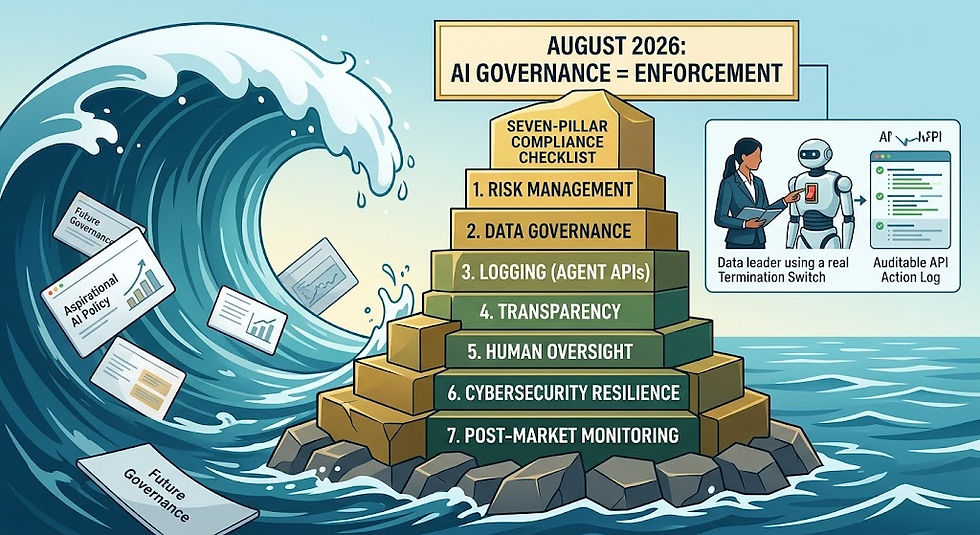
Governance and controls — the August 2, 2026 EU AI Act enforcement deadline did not soften because the platform got easier; logging, human oversight, purpose limitation, and kill switches remain your obligation
Workflow design — where the human attempts first, where the AI grades, where the manager coaches the difference; the platform does not decide that, your organization does
Middle-manager capability — the layer that decides adoption remains the frontline manager; a better runtime does not close a coaching gap
The organizations that mistake a managed platform for a full strategy will ship faster and stall sooner. The organizations that use the platform to buy back the time they were spending on plumbing — and reinvest it in the four things above — will pull decisively ahead in Q4 and into 2027.
What This Means for Data & AI Leaders
Five moves for Week 4 of September:
Sunset your undifferentiated plumbing — if you built session orchestration, context compaction, or agent state machines yourself, plan the migration to a managed harness deliberately
Reinvest the freed time into the four things platforms do not ship — codified expertise, governance, workflow design, and middle-manager coaching
Prepare for the ChatGPT Work Data agent (or its equivalent) to appear on real desks in your enterprise — the governance conversation about who can query what data is now urgent
Extend your risk register to voice and edge — full-duplex voice over phone lines is a new attack and exposure surface
Assume 40% embed by year-end is directional truth — your product suppliers are shipping agents in ambient updates; you will inherit them whether you sponsored them or not
A Moment of Reflection
Before the week closes:
What percentage of our current agent work is undifferentiated plumbing that a managed platform now handles for free?
Where will we reinvest that time — in the things platforms don't ship — and who owns each?
If the ChatGPT Work Data agent were quietly available to every employee tomorrow, would we be ready?
The managed agent moment does not mean the strategic question got easier. It means it got sharper. The plumbing has been paved over; the differentiation now lives everywhere else — in your knowledge substrate, your governance, your workflow design, your managers, and the specific bets you make about which problems to solve first. The winners of Q4 2026 will not be the enterprises that shipped an agent fastest. They will be the ones that used the managed platform to focus their scarce human effort on the four things no vendor can sell them. 🌊
Stay tuned for the next blog, and subscribe to the blog and our newsletter to receive the latest insights directly in your inbox. Together, let's make 2026 a year of innovation and success for your organization.
>> Discover the path to achieve sustainable growth with AI and navigate the challenges with confidence through our Data Science & AI Leadership Winning Blueprint that's tailored to help you craft a compelling data and AI vision and optimize your strategy—it's your key to success in the journey of Generative AI. Reach out for a complimentary orientation on the program and embark on a transformative path to excellence.

May you grow to your fullest in your data science & AI!
Subscribe Grow to Your Fullest and
Get Your FREE data & AI Leadership Blueprint, or
Book a FREE strategy call with us
Learn more Data & AI strategy consulting framework


Comments