
Navigating AI Model Tiers: What GPT-6 Astra, Sol, and Luna Mean for Enterprise Budgets

Five Frontiers Shipped in Ten Days. GPT-6 Arrived in Three Tiers. The Story Is Not Which One Is Smartest.
Data & AI Trends · October 2026
Five frontier models shipped in ten days. GPT-6 arrived in three price tiers. The story is not that another model is the smartest. It is that OpenAI just told the market — publicly, with numbers — what capability actually costs. And the numbers change how Q4 budgets should read.
In early September 2026, the frontier moved five times inside ten days. Claude Fable 5.1. GPT-6 Astra. Gemini 3.8 Flash. Muse Spark 1.3. DeepSeek V4.1-Flash. Each landing was, on its own, a launch worth reading. Together they were the sound of the enterprise AI cost curve breaking into a new shape. The most consequential piece of that shape is not any single model. It is the fact that OpenAI shipped GPT-6 in three named tiers — Astra, Sol, and Luna — at three deliberately distinct price points, and the market now has a public reference for what different qualities of frontier reasoning are actually worth.
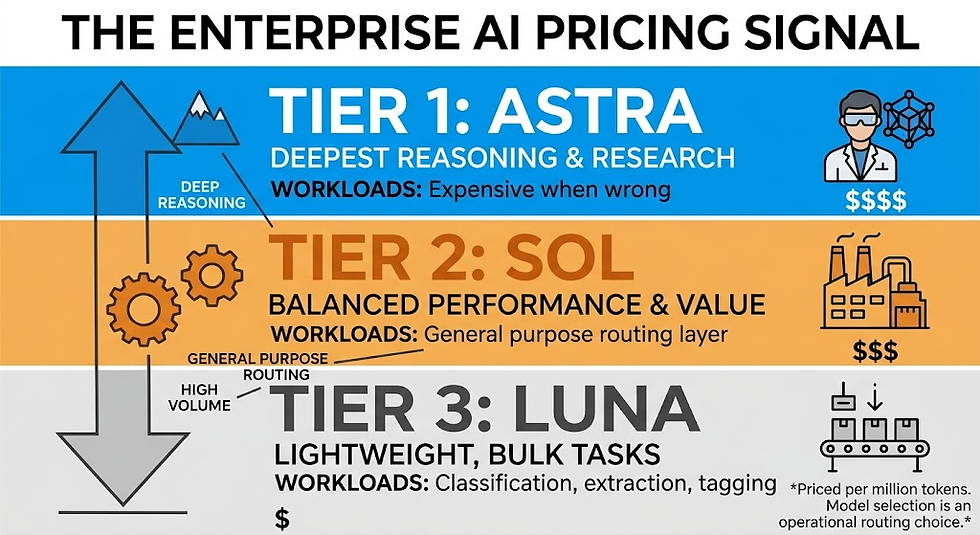
Astra is the top of the stack, positioned as the most capable of the family. Sol is priced at $2 per million input tokens and $10 per million output. Luna is priced at $0.10 per million input and $0.50 per million output — twenty times cheaper on input, twenty times cheaper on output. Read those numbers not as a menu, but as a diagnosis. OpenAI has just published the shape of the price war that every enterprise budget will be re-drawn against for the rest of the year.
The Three-Tier Reading of the Frontier
A tiered frontier is not new. What is new is how brazenly the tiers now describe distinct enterprise workloads, not distinct customer segments. Astra is the model for the questions where being wrong is expensive — the hardest reasoning, the deepest research, the workloads where you cannot afford to have used the cheaper option and hoped. Sol is the model for the workloads where you want frontier-class capability without frontier-class pricing — the general-purpose intelligence layer that a mature enterprise routes most of its meaningful traffic through. Luna is the model for the workloads where volume beats depth — the classification, extraction, tagging, and lightweight generation that make up the bulk of enterprise inference by count, even though they carry less weight per call.
The right question in Q4 2026 is not "which one is the smartest?" It is "how do we route our workloads across these three, and does our existing architecture even let us?" That is not a shopping question. That is an operating-model question. And for many enterprises, it will surface an uncomfortable truth: their current AI infrastructure was built to call one model, well, and everything else was scaffolding around that one call. A three-tier frontier is not a menu you shop from once. It is an architecture you route across, continuously, at real-time cost.
Reasoning Models Are Now the Default, Not the Feature
Alongside the tiering, one architectural shift has quietly become the new baseline. Extended thinking — the deeper, slower reasoning that used to be a niche capability of dedicated reasoning models like OpenAI's o1 — now ships by default in frontier models across the board. Claude Opus 5, GPT-5.6 Sol, Gemini 3.1 Pro, and their newest siblings all treat extended thinking as a first-class mode, and "deep research" variants trade latency for accuracy on the hardest workloads. For an enterprise, this means the difference between a model that thinks and a model that does not is no longer a product decision. It is a routing decision. Some queries deserve the deeper thought. Some do not. The infrastructure that decides which is which — cheaply, quickly, and correctly — is the new competitive layer.
Five Launches, One Underlying Shift
The five launches — Fable 5.1, GPT-6 Astra, Gemini 3.8 Flash, Muse Spark 1.3, DeepSeek V4.1-Flash — are worth reading as one signal, not five. Every serious frontier vendor is now shipping capability across a spread of price points on a compressed release cadence, and the differences between vendors on any single tier are narrowing quickly. Claude Fable 5.1 is competitive on efficiency. Gemini 3.8 Flash is competitive on speed and cost. DeepSeek V4.1-Flash is competitive on cost per capability at a level that was unthinkable a year ago. Muse Spark 1.3 opens weights that would have been proprietary in 2025. Read as a group, they are telling the market that no single vendor is going to hold a durable capability lead at any given tier for more than a quarter or two — and that pricing power is going to move to the layer above the model.
This is the same lesson the August moment already began to teach and the September Agents API confirmed. The moat is not the model. It is not the runtime. The moat lives above them, in the routing, the workflow, the codified expertise, and the daily work layer where the intelligence actually gets used. The three-tier frontier just published the price sheet that makes this truer, more visible, and more urgent than it was in August.
What This Actually Changes for the FY2027 Budget
For an enterprise executive planning next year's AI spend, four practical implications follow directly from the tiered pricing:
Aggregate cost per query is about to fall meaningfully for the majority of enterprise workloads that route sensibly to Sol or Luna — but only for enterprises whose architecture actually routes
Aggregate cost for the small share of workloads that genuinely require Astra-class reasoning will not fall much, and may rise as more of them get correctly identified — that is not a failure of budgeting, it is the price of doing the reasoning tier honestly
The infrastructure investment that pays back fastest in FY2027 is a routing and evaluation layer that decides which tier each workload actually needs — this is where cost curves and quality curves both improve fastest
Any assumption in the FY2027 budget that pricing per token will stay flat is already stale — model the tiered pricing directly, and the cost line will read differently
A Question Before the Budget Closes
Before the FY2027 AI budget is set, sit honestly with these:
If we were forced today to publish, per workload, which tier we route it to and why — could we?
How much of our current model spend is going to a tier the workload doesn't actually require, and how much is going to a tier that quietly compromises the workload's quality?
Is the FY2027 architecture line item funded to build the routing and evaluation layer that the three-tier frontier now assumes we have — or is it a line item that quietly assumes another year of one-model-fits-all?
Five launches in ten days is the noisy part of the story. The three-tier frontier is the quieter and more consequential part. Enterprises that treat GPT-6 Astra, Sol, and Luna as a shopping menu will save some money and quietly waste more. Enterprises that treat them as the architecture the industry has now agreed on — and that build the routing, evaluation, and workflow layer that this architecture assumes — will spend the same money and produce measurably better outcomes. The frontier just told the market what capability costs at each tier. The only remaining question is whether your FY2027 architecture is being built to actually use that information.
If a candid conversation about your own routing strategy for choosing AI model tiers would be useful before the budget closes, a short strategy call is one place to start. The pricing sheet is public.
The advantage is in whether you build to it. 🌊
Stay tuned for the next blog, and subscribe to the blog and our newsletter to receive the latest insights directly in your inbox. Together, let's make 2026 a year of innovation and success for your organization.
>> Discover the path to achieve sustainable growth with AI and navigate the challenges with confidence through our Data Science & AI Leadership Winning Blueprint that's tailored to help you craft a compelling data and AI vision and optimize your strategy—it's your key to success in the journey of Generative AI. Reach out for a complimentary orientation on the program and embark on a transformative path to excellence.

May you grow to your fullest in your data science & AI!
Subscribe Grow to Your Fullest and
Get Your FREE data & AI Leadership Blueprint, or
Book a FREE strategy call with us
Learn more Data & AI strategy consulting framework


Comments