
AI Workforce Transformation: Why Redesigning Work Beats Replacing Jobs

The Skills, Roles, and Collaboration Models AI Leaders Must Redesign This Week
August 17 – August 23, 2026: BUILD THE FUTURE — Workforce Transformation
Guiding Question: How should we adapt?

This week's research confirms something I have been telling my clients all year: AI is not eliminating jobs at the pace the headlines promised. It is rewriting them, one task at a time, faster than most organizations are rewriting how work actually gets done.
What's changing this week:
Roles are splitting into two tracks — one where AI multiplies human judgment, one where AI absorbs the whole task
Hiring criteria are shifting from credentials to demonstrated judgment
Managers are becoming the missing layer between AI capability and real adoption
Productivity gains are concentrated in the minority of companies that redesigned work, not just deployed tools
Reframe question: If AI is available to everyone on your team today, what actually separates the people — and companies — pulling ahead from the ones standing still?
The honest answer, based on this week's data: it is not access to the tool. It is the willingness to redesign the work around it.
Workforce Transformation: AI Is Reshaping Work More Than Replacing It
PwC's newly released 2026 Global AI Jobs Barometer, which analyzed more than one billion job postings across six continents, found something every leader should sit with: AI is creating a “two-track” labor market, not a single wave of job loss. “Professionalised” roles — where AI automates the routine parts of a job and human judgment, creativity, and leadership become more valuable — are growing twice as fast and paying 42% faster in salary growth than “democratised” roles, where AI simply makes the job easier for anyone to do.
The gap compounds at entry level. PwC's analysis of nearly 2.4 million U.S. entry-level job postings found that roles most exposed to AI are now seven times more likely to require traditionally senior skills like leadership and judgment — and those roles have grown 35% since 2019, while other entry-level roles shrank 10%.
BCG's companion research points to the same shift from a different angle: frontline AI adoption has surged to 74% of employees using it regularly, and the firm now projects that 50% to 55% of U.S. jobs will be reshaped — not eliminated — by AI within the next two to three years.
I read this as good news wrapped in a warning. The good news: this is not primarily a story of jobs disappearing. The warning: if your organization has not deliberately decided which roles become “professionalised” and which skills your people need next, the market will decide for you.
My recent piece, The Human Advantage in an AI World, explores why this shift rewards what machines still cannot replicate — creativity, ethical reasoning, and the ability to make meaning out of ambiguity. As AI absorbs more of the routine, the human advantage becomes sharper, not smaller.
Leadership takeaway: Map your team's roles onto the professionalised/democratised split this month. It will tell you exactly where to invest in reskilling first.
Skills & Career Growth: What Can You Do With AI That Creates Leverage?
The question every ambitious professional should be asking right now isn't “What AI tools do I know?” It's “What can I do with AI that creates leverage no one else on my team has?”
The data backs this up. The World Economic Forum estimates more than half of the global workforce will need meaningful reskilling or upskilling within the next four years. Workers who can demonstrate real proficiency in AI-related competencies earn, on average, 56% more than peers in comparable roles without those skills — and PwC's data shows the AI skills wage premium has climbed to 62% globally, as high as 118% in some sectors.
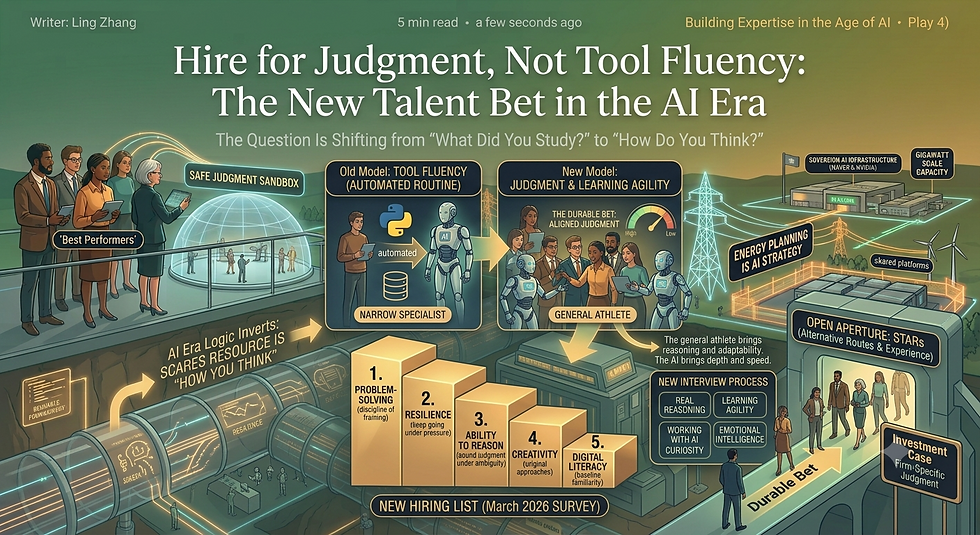
But the skill that pays isn't tool fluency. It's judgment. In my recent post, Hire for Judgment, Not Tool Fluency: The New Talent Bet in the AI Era, I unpack why hiring managers are shifting the interview question from “What did you study?” to “How do you think?” — and why the durable career investment right now is building judgment that is specific to your firm and industry, not generic tool skills that any AI can replicate for the next person too.
Leadership takeaway: When you evaluate your own career or your team's development plan this quarter, ask which skills create leverage that compounds — and which skills are simply keeping pace with a tool everyone already has.
Human + AI Collaboration: From Functional Silos to Orchestrated Work
Here is where most organizations are quietly failing. Deloitte's 2026 Global Human Capital Trends research found that 63% of C-suite leaders believe redesigning work for AI and automation will deliver the highest people-related return on investment this year. Yet only about one-third feel their workforce is actually equipped to combine human and AI capabilities effectively — and by Deloitte's own count, only 6% of leaders report real progress designing how humans and AI actually interact inside a workflow.
That gap is not a technology problem. It is a leadership and orchestration problem.
My recent piece The Preceptor Model: Why Manager Coaching in the AI Era Is the Missing Layer in AI Adoption names exactly where this breaks down: managers are no longer just supervising work, they are shaping how their people think, communicate, and engage with AI day to day — and organizations that skip investing in that coaching layer end up with expensive tools and unchanged habits. Read more: The Preceptor Model
Six questions worth asking as you build your own orchestration model:
Where does a human make the final call, and where does AI act autonomously?
Who is accountable when AI and human judgment disagree?
How does information flow between functions that used to work in silos?
What does “good” collaboration between a person and an AI agent actually look like in your workflows?
Are your managers equipped to coach this collaboration, or just to approve it?
How will you know orchestration is working, beyond adoption numbers?
Leadership takeaway: Redesigning work is a coaching investment before it is a technology investment.
Productivity: AI Does Not Automatically Create Better Work
This is the section every executive needs to read twice. A new NBER working paper, “Firm Data on AI” (Yotzov, Barrero, Bloom, et al., 2026), surveying nearly 6,000 executives across the US, UK, Germany, and Australia, found that over 80% of firms report no measurable impact from AI on either employment or productivity over the past three years — even though roughly 70% of firms have already adopted it.
That is not an argument against AI. It's an argument against deploying AI without redesigning the work around it. A 2026 Stanford study of 1,200 enterprises found the same pattern from the other direction: companies in the top quartile of AI adoption maturity saw productivity gains of 25% to 40% in the functions where they deployed AI, while companies in the bottom two quartiles saw only 5% to 10% gains — and some saw productivity dip during the transition. The difference wasn't the technology. It was whether the company redesigned the workflow around the tool, or just handed people an assistant and left the process untouched.
Ways organizations are redesigning work around AI right now, not just adding it on top:
Rebuilding workflows from the desired output backwards, instead of inserting AI into an unchanged process
Redefining what “done” looks like for a task now that a first draft takes minutes, not hours
Reassigning judgment-heavy review work to the people AI freed up from routine tasks
Measuring team output and quality, not just AI usage rates
Leadership takeaway: If your organization has deployed AI but hasn't redesigned the surrounding workflow, don't expect productivity numbers to move. The tool is necessary. It is not sufficient.
How Mid-Level Data & AI Leaders Should Adapt
Audit your own role against the professionalised/democratised split — know which side you're on before your organization decides for you.
Build judgment, not just tool fluency — take on the ambiguous, cross-functional problems no one has fully solved yet.
Become the coach, not just the user — the managers and leads who can teach others how to work with AI will be the ones organizations depend on most.
Document how you make decisions — codified judgment becomes the training ground for the next generation of your team, human or AI.
Volunteer to redesign a workflow, not just adopt a tool — this is where the visible impact and the career leverage both live.
How Executive Leaders Should Adapt
Eight diagnostic questions worth bringing to your next leadership meeting for AI workforce transformation:
Do we know which of our roles are “professionalised” versus “democratised” by AI, and are we resourcing them differently?
Have we redesigned any workflow from the output backward, or have we only added AI on top of existing processes?
Are our managers equipped and incentivized to coach AI collaboration, or only to approve its use?
Do we measure productivity and quality outcomes, or just adoption and usage metrics?
What percentage of our workforce has a real reskilling plan, not just access to a tool?
Where does human judgment make the final call in our highest-stakes workflows, and is that boundary written down anywhere?
Are we investing in the “missing layer” — manager coaching — or only in the technology layer?
If a regulator, board member, or new hire asked us to explain our human + AI operating model in one sentence, could we?
Investment areas worth prioritizing this quarter:
Manager coaching and enablement programs
Workflow redesign sprints, not just tool rollouts
Judgment-based hiring and promotion criteria
Shared language and metrics for human + AI collaboration across functions
Practical Adaptation Exercise
Take one workflow your team touches every week and map it against these four questions:
What does AI do best in this workflow today?
What does a human need to do that AI cannot yet replicate?
Where does the handoff between human and AI happen, and is it designed or accidental?
What would “redesigned,” not just “AI-assisted,” look like for this exact workflow?
Final question: If you redesigned this one workflow well, what would that make possible for the rest of your team?
Closing Reflection: How Should We Adapt?
We adapt by building judgment before the market forces us to prove we have it.
We adapt by treating managers as the missing layer, not an afterthought.
We adapt by redesigning the work, not just deploying the tool.
We adapt by measuring what actually changed, not just what got adopted.
And we adapt with humility — trusting that the same wisdom that has guided every season of change in our lives and careers is available for this one too.
Ready to Grow Into Your Next Level?
If your organization is investing in AI but struggling to turn activity into measurable business value, my AI & Data Strategy Consulting Framework can help you build a clear, governed, value-driven roadmap.
If you are a Data & AI leader who wants to grow from technical contribution to strategic influence, my Data & AI Leadership Winning Blueprint can help you strengthen your executive presence, communication, and transformation leadership.
If you are navigating career growth, personal growth, or leadership reinvention in the AI era, my coaching programs can help you clarify your next chapter and grow with confidence.
And if you want to approach the second half of the year with greater financial clarity, my financial education and holistic check-in conversation can help you review protection, risk, growth, and tax through the lens of the life you are building.
You do not have to navigate this season alone. Book a complimentary strategy conversation and take your next step toward leading, growing, and building with clarity, confidence, and purpose.

May you grow to your fullest in your data science & AI!
Subscribe Grow to Your Fullest and
Get Your FREE data & AI Leadership Blueprint, or
Book a FREE strategy call with us
Learn more Data & AI strategy consulting framework


Comments