
AI Scaling vs Value: How Leaders Are Turning Massive Deployment into Real Returns

Forty Percent of Large Enterprises Are Now Scaling AI Agents. The Number Moving Fastest Is Not the One on Your P&L.
Data & AI Leadership · October 2026 · The AI Pulse
Forty percent of large enterprises are now scaling AI agents, up from twenty-seven a year ago. The number moving fastest is not the one on your P&L. Scaling was never supposed to be the finish line.
McKinsey's "The State of AI 2026" (August 25, 2026) reports that 40% of respondents from large organizations are now scaling AI agents — a 13-point jump in a single year. The same report notes that only 37% of respondents attribute at least some EBIT impact to AI use, about the same share as last year. Adoption accelerated. Value did not. For an accountable executive walking into a Q4 budget cycle, that single sentence contains most of what needs to be said about the year.
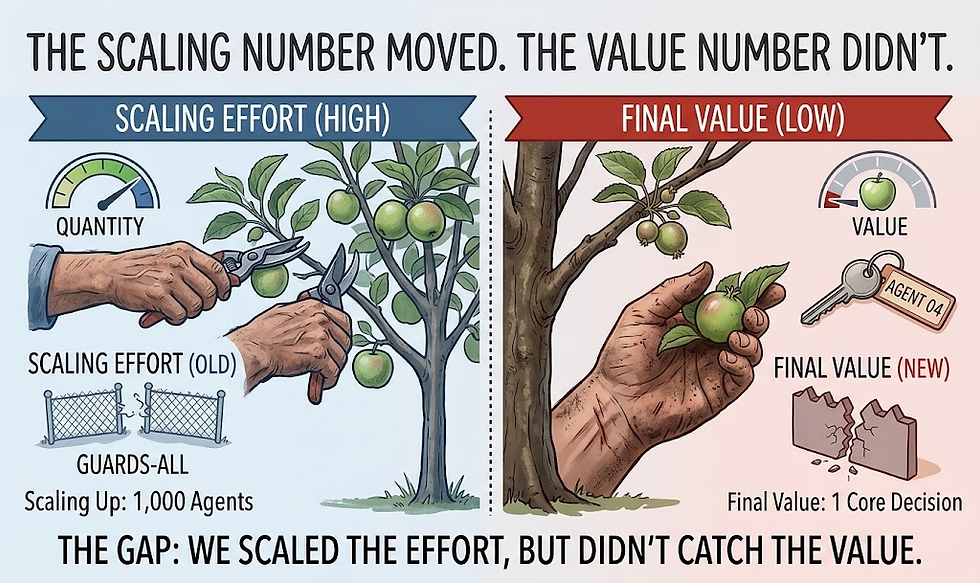
Two Numbers, One Uncomfortable Truth
Let the numbers do the work. Scaling: 27% → 40%. Value: 37% → about 37%. If those two lines were on the same chart, one is a curve accelerating upward and the other is a flat pencil-stroke. That is not an anomaly. It is a pattern the industry has been quietly generating for two consecutive years now. The WRITER 2026 survey found that 48% of leaders now describe AI adoption as "a massive disappointment," up from 34% in 2025 — the same shape of disappointment showing up in a different data set. Two data points do not always make a trend. Two data points shaped identically, from independent sources, in the same year, do.
Why This Happens — the Difference Between Deploying and Redesigning
The gap between scaling and value is not a technology problem. It is a design problem, and it repeats predictably. Enterprises deploy agents on top of workflows that were built for a pre-agent world. The agent runs, produces output, and gets counted as "scaled." But the surrounding process — who acts on the output, when, with what authority, tied to what decision, measured against what outcome — was never redesigned to convert that output into a business result. The agent is present. The value creation loop is not.
This is why "scaled" and "value-producing" can diverge so sharply. Scaling measures deployment surface. Value measures whether the surrounding operating model changed. Most enterprises spent 2025 and 2026 mastering the first. Very few spent the same effort on the second. The dashboards celebrate what was easier to measure. The P&L reports what was harder to change.
The Redesign Nobody Wants to Fund
Redesigning how value actually gets created — as opposed to layering agents on top of how it used to get created — is unglamorous work. It requires questioning the process every existing stakeholder is comfortable with. It requires moving decision rights, adjusting incentives, retiring old dashboards, and rewriting SOPs that reference procedures the agent has quietly replaced. It requires the operating model — not the tech stack — to move. It is the exact work that boards fund reluctantly because it does not photograph well and it does not fit inside a single quarter.
But the McKinsey numbers are, at this point, telling every leader the same thing. Continued investment in scaling without the same investment in redesign will keep producing exactly what the last two years produced: more agents in more places, and a P&L line that does not move. The organizations that will show up in the 2027 version of this report on the other side of the gap will be the ones that decided, in Q4 2026, to spend more effort on the operating model than on the deployment surface.
What Would Move Both Numbers Together
For any AI initiative currently in flight, three questions separate the ones that will move both numbers from the ones that will only move one:
What decision does this agent actually change — and who holds accountability for the outcome of that decision now that it has changed?
What in the surrounding process — approval chains, incentives, dashboards, SOPs — has been redesigned to convert the agent's output into a P&L result, and what is still operating as if the agent did not exist?
How would we measure whether this initiative produced EBIT impact — not activity, not usage, not adoption — over the next four quarters, and who owns that number?
Every initiative that cannot answer all three cleanly is a candidate for the scaling column and the flat-value column simultaneously. Every initiative that can answer all three is a candidate for the small, quieter category of programs that actually move the P&L.
The Budget Cycle Question
For the accountable executive setting FY2027 priorities, one honest look at the current AI portfolio, through these three questions, will usually surface the same finding. A meaningful share of what is currently classified as "scaled AI" is really "deployed AI on top of unchanged operating models." Reclassifying it — not renaming it, actually funding the operating-model work that was skipped — is the single highest-leverage move the FY2027 budget can carry. It costs less than the next round of agent expansion, and it is the only investment likely to bend the value curve that has stayed flat for two consecutive years.
A Question Before Your Next Budget Meeting
Before the next AI budget conversation, sit honestly with these:
If our own "scaling" number and "value" number were plotted side by side over the last twelve months, would they be moving together or diverging?
Which of our currently scaled AI initiatives has genuinely redesigned the surrounding operating model, and which is layered on top of a process built for a pre-agent world?
What percentage of our FY2027 AI investment is going to more deployment surface, and what percentage is going to the operating-model work the McKinsey numbers say is the actual bottleneck?
Scaling was never supposed to be the finish line. It was supposed to be the starting line for the value creation the P&L eventually reports. Two years of the same disappointing gap between the two suggests the industry as a whole has been treating the starting line as the finish. The leaders who reverse that assumption in Q4 2026 — who spend the next quarter on operating-model redesign rather than on more scaling — will be the ones whose FY2027 numbers finally start to move together.
If a candid conversation about which of your current initiatives is really moving both lines would be useful before the budget closes, a short strategy call is one place to start. The math is not complicated. The discipline of doing it honestly, before another year passes, is what actually changes it. 🌊
Stay tuned for the next blog, and subscribe to the blog and our newsletter to receive the latest insights directly in your inbox. Together, let's make 2026 a year of innovation and success for your organization.
>> Discover the path to achieve sustainable growth with AI and navigate the challenges with confidence through our Data Science & AI Leadership Winning Blueprint that's tailored to help you craft a compelling data and AI vision and optimize your strategy—it's your key to success in the journey of Generative AI. Reach out for a complimentary orientation on the program and embark on a transformative path to excellence.

May you grow to your fullest in your data science & AI!
Subscribe Grow to Your Fullest and
Get Your FREE data & AI Leadership Blueprint, or
Book a FREE strategy call with us
Learn more Data & AI strategy consulting framework


Comments