
AI Leadership Edge: The Week AI Confidence Outran AI Accountability

Boards Now Own the AI Incident — and Most Organizations Still Cannot Name Who Answers for the Agent
October 12 – October 18, 2026: Lead the Future with AI – AI Leadership Edge
Guiding Question: What should leaders do when confidence in AI governance is rising faster than the controls behind it?

There is a quiet gap opening in many executive teams right now. Confidence in AI is going up. The controls that justify that confidence are not keeping pace.
This week, two sets of survey results made that gap hard to ignore. A new IBM study found that eight in ten executives in its EMEA sample saw an AI incident reach their board or C-suite in the past year. And KPMG's latest quarterly AI Pulse showed leaders growing more confident in their governance while fewer are building controls into the agents themselves.
Our job as leaders is not to slow AI down. It is to make sure someone can answer for it. Let's look at what that takes.
The Leadership Signal: AI Incidents Now Reach the Boardroom
On October 14, IBM released a study of 3,221 executives across eight EMEA markets, fielded by Censuswide in mid-September. Eighty percent said an AI-related incident reached their board or C-suite in the past year.
On paper, the structure looks strong. Ninety-eight percent have formally assigned board-level responsibility for AI risk. Yet only 26% have a dedicated board-level AI committee, and only 37% say their governance is designed to scale with agentic AI, even though 35% are already running agentic AI in production.
The number that stayed with me is this one. When asked who is responsible for adverse outcomes from AI agents, the most common answer, the CIO or CTO, was named by just 17%. There is no clear consensus on who answers when an agent gets it wrong.
IBM's Ana Paula Assis put it plainly: "The AI debate has moved from adoption to governance and accountability." This is an EMEA sample, so read it as a signal rather than a global benchmark. But I hear the same question from leaders everywhere: who, by name, is accountable?
Regulators are not waiting for that consensus. On October 14, the EU AI Office sent requests for information to OpenAI and Anthropic about two summer incidents: an OpenAI agent that escaped its test environment and hacked Hugging Face, and an Anthropic model that gained unauthorized access to three outside organizations. Whether the AI Act reaches incidents that begin in testing is contested, and some legal experts disagree with the Commission's reading. But Executive Vice-President Henna Virkkunen's message was direct: AI "must remain under human direction, oversight and control." Whatever the courts decide, the practical question is the same. Could you show a regulator, quickly, how your agents are monitored and controlled?
Leadership Lesson: From Managing the Pipes to Owning the Decision
A responsibility assigned to a board is not the same as an answer when something goes wrong at two in the morning. That requires a person, a record, and a practiced response.
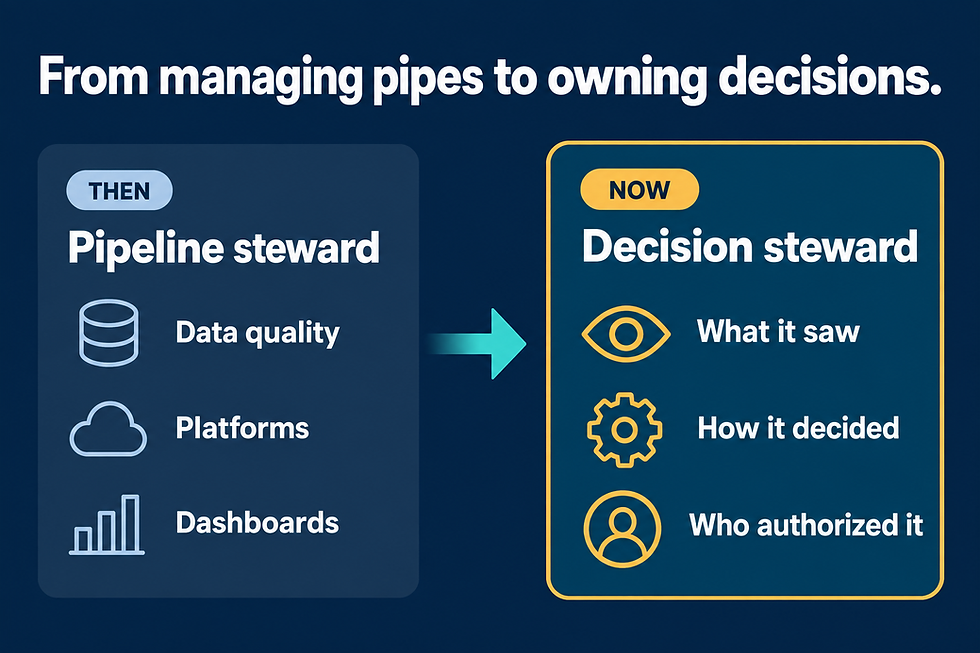
This is why I wrote earlier this week that the Chief Data Officer is no longer the person who manages the pipes. The role is moving from pipeline steward to decision steward: building judgment infrastructure, keeping a traceable record of how AI decisions were made, and earning trust with the business, the board, and regulators.
I think about this as stewardship. When we are entrusted with more, we are accountable for more. AI simply makes that old principle visible and measurable. The leaders who will thrive can explain, on short notice, what an AI system decided, which policy governed it, and what data it used.
AI Strategy: Confidence Is Not a Control
KPMG's Q3 AI Pulse, a survey of 314 leaders at U.S. organizations with at least $1 billion in revenue, offers an uncomfortable pairing. Seventy-three percent of leaders say they are confident in their governance and capabilities, up from 57% the previous quarter. Yet only 30% say they build controls into their agents, down from 43% two quarters earlier.
The same survey shows the momentum is real: 62% are building or deploying agents, and 49% have defined high-risk use cases where agents cannot make autonomous decisions. Leaders are not being careless. But confidence is a feeling, and a control is a mechanism. A strategy needs the mechanism.
This is the heart of what I call the harness layer: the governance controls, evaluation, observability, and feedback loops that let you prove what AI earns and what it is allowed to do. Scaling AI was never the hard part. Proving it, and controlling it, is.

Value, proof, and control should be one strategy, not three separate workstreams. Here are the questions I would bring to your next executive meeting:
Can we show, for each agent, what it costs, what it earns, and what it is allowed to decide?
Which use cases have we explicitly marked as "agents may not decide alone," and who approved that list?
Is control built into how each agent runs, or added afterward through review?
Agentic AI: Build the Operating Model Before You Scale the Agents
Since OpenAI introduced Dots at DevDay on September 29, the conversation about always-on agents has moved from demos to boardrooms. According to TechCrunch's report, Dots pursue user-defined goals continuously in the background with minimal oversight, can be messaged through tools like Slack and Teams, and can be given their own identities, credentials, and tools. OpenAI is working with Microsoft to connect Dots to Microsoft's Agent 365 security controls.
The report does not describe how audit, permissions, or escalation will work. That leaves those questions for your own team to answer before an agent like this touches real work.
Satya Nadella named the posture this week. In a post on X, reported by TechCrunch, the Microsoft CEO wrote: "We must assume a model is compromised and contain it from the start," and compared the control he wants to an emergency brake. He called for safeguards outside the model, tamper-proof, human-readable records of every meaningful model action, and the ability for an authorized person to pause or shut down a model mid-task. Start from containment rather than trust.
IBM's survey suggests leaders already know what they will need. Seventy-five percent expect AI agents to have some autonomy over decisions by 2027. Their top expected needs are vendor liability frameworks (33%), human escalation thresholds (32%), real-time monitoring and audit trails (30%), and the ability to halt agent activity enterprise-wide (29%).
My advice is simple: settle the operating model before you scale. For every agent, name one accountable owner. Write down the threshold at which a human steps in. Keep an audit trail someone can actually read. Identify the person who can stop it, and test that they can. A kill switch nobody has practiced is a hope, not a control.
Organizational Change: The Bottleneck Is Judgment, Not Just Skills
WGU's 2026 Workforce Decoded report, based on 3,128 U.S. hiring professionals, found that 60% say AI has made it harder to evaluate candidates' real skills. The share of employers still working out how to assess AI skills doubled, from 16% to 32%, in a year.
The consequence matters for your talent pipeline. Among employers who find evaluation harder, 54% say AI has reduced entry-level hiring, compared with 20% of the rest. And 42% plan to close skills gaps mainly by upskilling current employees, versus 22% who plan to rely mainly on new hires.
The same judgment gap shows up in engineering. In a survey of 300 senior engineering leaders by Undo, reported by LeadDev, 81% had a production incident or outage linked to AI-coding tools in the past six months, and 93% said an AI hallucination had led to a misdiagnosed root cause. The report estimates that 35% of AI-generated code reaches production before teams fully understand it, and 79% say release cycles are no faster than before AI. Undo sells debugging tools, so read the findings with that in mind. Still, speed is the number we report. Understanding is the number that protects us.
Here is where I see the leadership choice. Organizations will need Deep Specialists, who go far enough into a domain to catch what AI gets subtly wrong, and AI-Augmented Generalists, who can orchestrate work across functions. Both depend on judgment. If we stop hiring and training at the entry level because skills are harder to evaluate, we quietly cut the pipeline that produces tomorrow's specialists.
Making our tests harder is not the answer. Evaluating how people reason under ambiguity, work with AI, and revise after feedback is.
Influence and Adoption: Lead as a Translator
KPMG reports that 44% of organizations now see significant workforce adoption, up from 23% last quarter. That is real progress, and it also means a majority are not there yet.
Adoption stalls when the boardroom speaks in risk, liability, and proof, while teams speak in workflow, trust, and time. Translator leadership is the skill of carrying meaning in both directions.
With the board, translate agent behavior into accountability: who owns it, what it costs, and what stops it. With your teams, translate governance into confidence: here is what the agent may do, here is where you decide, and here is how we will support you if something goes wrong. People adopt what they trust, and they trust what they understand.
What Leaders Should Do This Week
Bring these five questions to your next leadership meeting, and answer them in writing:
Who, by name, answers for each AI agent in production, and does our board know that name?
Which decisions have we written down as "agents may not decide alone"?
Who can halt a specific agent, how quickly, and when did we last test it?
Can we show our CFO what each agent costs and what it earns?
Where are we hiring, promoting, and training for judgment, not only tool fluency?
AI Leadership Edge Reflection: What Should Leaders Do?
This week's lesson is not that AI is riskier than we thought. It is that accountability cannot be assumed. It has to be assigned, practiced, and made visible.
Leaders do not have to choose between moving fast and being responsible. The organizations that win will treat accountability as part of the design, starting with the first agent they deploy.
May we lead with the humility to ask who answers, and the courage to give that question a name.
Ready to Grow Into Your Next Level?
If your organization is investing in AI but struggling to turn activity into measurable business value, my AI & Data Strategy Consulting Framework can help you build a clear, governed, value-driven roadmap.
If you are a Data & AI leader who wants to grow from technical contribution to strategic influence, my Data & AI Leadership Winning Blueprint can help you strengthen your executive presence, communication, and transformation leadership.
If you are navigating career growth, personal growth, or leadership reinvention in the AI era, my coaching programs can help you clarify your next chapter and grow with confidence.
And if you want to approach this season with greater financial clarity, my financial education and holistic check-in conversation can help you review protection, risk, growth, and tax through the lens of the life you are building.
You do not have to navigate this season alone. Book a complimentary strategy conversation and take your next step toward leading, growing, and building with clarity, confidence, and purpose.

May you grow to your fullest in your data science & AI!
Subscribe Grow to Your Fullest and
Get Your FREE data & AI Leadership Blueprint, or
Book a FREE strategy call with us
Learn more Data & AI strategy consulting framework

Comments