
AI Governance Program: Congress Is Stalled. The Voluntary Pledge Was Signed. You're Not Waiting for Either.

Congress Is Stalled. The Voluntary Pledge Was Signed. You're Not Waiting for Either.
AiFullest · November 2026 · AI Governance Program
Congress is stalled on AI safety legislation. The industry did not wait. On September 29, 2026, the CEOs of Google, Anthropic, Meta, and OpenAI signed a voluntary commitment with the White House to strengthen frontier AI safeguards. California and New York are separately writing their own rules. Two-thirds of registered voters say they want more AI regulation, not less. If you are the executive responsible for your organization's AI governance program, here is the uncomfortable truth in that gridlock: clarity was never coming on a timeline you could plan around. You build the program because waiting was never actually the safe option.

That is a different mental model than the one most governance programs are being run on today. Most are being built as if a final rulebook is coming — a definitive EU AI Act equivalent, a bipartisan federal framework, a settled set of enforceable standards — and the program's job is to translate that rulebook into internal practice. When the rulebook does not arrive, programs stall. The ones that keep moving are the ones that stopped waiting for the rulebook and started building against the direction of travel.
What the Federal AI Regulation Picture Actually Looks Like Right Now
Three facts worth putting in front of a leadership team, together, in the same sentence:
Senate bipartisan AI safety talks reached a standstill by late September 2026. The House bipartisan Frontier Act (Obernolte/Trahan) would let Commerce suspend a model deemed to pose an imminent catastrophic risk — with no committee vote date committed.
On September 29, Trump and the CEOs of Google, Anthropic, Meta, and OpenAI signed a voluntary commitment to strengthen frontier AI safeguards. Voluntary. Not enforceable. Signed anyway.
66% of registered voters say they want more AI regulation, per an early-October Navigator poll. The public mandate is bipartisan and the direction is one-way.
Read those three together and the picture is clear. Federal legislation on a committed timeline is not coming. But the environment every AI governance program will be judged in — by boards, by state regulators, by customers, by employees — is already being set, by actors who are not Congress.
Why Your AI Governance Program Cannot Wait for Clarity
The uncomfortable question for every leader with AI governance in their portfolio right now is this: if nothing passed at the federal level in the next eighteen months, would your current program be defensible? Not legally — defensibly. The organizations that will come out of 2027 in good shape are the ones whose answer today is yes. The ones who answer no are the ones who have been building against a rulebook that was never going to arrive on their schedule. The CFO Dive framing of this moment is worth sitting with: the growing focus on AI safety is expected to force C-suites to step up their risk management and governance efforts, with CFOs playing a central role. When the risk conversation moves to the CFO's calendar, the governance program is no longer a compliance project. It is a board-level investment decision.
The context on how this plays out in practice — not in a policy memo, but in actual operating-model terms — is laid out in
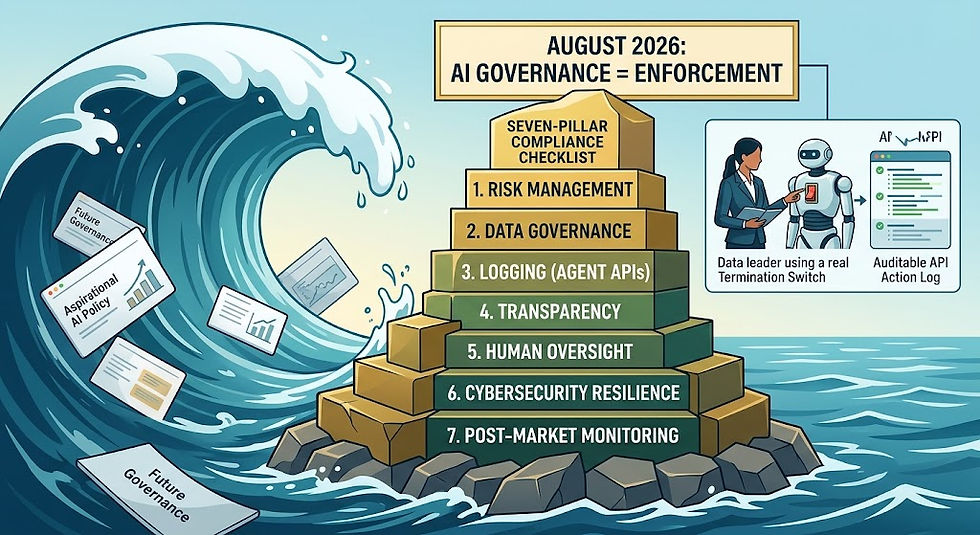
Governance Just Became Enforcement. The adjacent question — who, by name, owns an AI agent when it makes a mistake — is covered in AI Agent Accountability: Who Owns the Agent When It Makes a Mistake?.
What Changes About How You Build When the Rulebook Isn't Written Yet
The AI governance program that gets built against a specific regulation is a document. The AI governance program that gets built against the direction of travel is an operating capability. The two look similar on an org chart and act very differently in the first incident. Four things change when you build for direction rather than rule:
Your framework references principles that will show up in any eventual regulation, not clauses of a specific one. Transparency, accountability, data provenance, human oversight, model risk management — these are the invariants.
Your controls are instrumented continuously, not sampled annually. The regulation when it comes will ask for audit evidence; the program that can produce it in hours rather than weeks will not have to retrofit.
Your decision-making authority is already named. Not a committee. A person, with the budget and the mandate to pause an AI capability without waiting for a quarterly review.
Your vendor contracts carry the clauses you expect the regulation to require, before it does. The contract terms that will matter — data residency, model change notification, incident disclosure timelines — do not get easier to negotiate after a rule arrives. They get written on the vendor's timeline, not yours.
The Three Practices Separating Organizations Ready vs. Reacting
From the leaders we work with who are getting this right, three practices consistently separate the organizations whose AI governance program is already defensible from the ones who are still waiting for the rulebook:
Named accountability per AI capability. For every production AI system, there is one person — not a committee — who can be identified by name as the owner. The three questions that make this real: who stops it, who signs off on scope changes, who runs the postmortem.
A written risk register the board reads. Not a GRC-tool export. A short, written document — updated quarterly — that lists every AI capability in production, its risk category, its named owner, its last review date, and the one incident scenario that would require escalation.
A tested kill switch per production AI capability. Not a theoretical pause button. A specific, named procedure that has been rehearsed at least once in the last twelve months. If the drill has not been run, the switch does not exist.
None of these three require a specific federal regulation to be in place to begin. All three will be required by any serious regulation that eventually arrives — and by the first serious incident, whichever comes first.
A Question Worth Sitting With Before the Next Board Meeting
Before your next AI governance or risk review:
If no federal AI legislation passed in the next eighteen months, would our current AI governance program be defensible to our board — not legally defensible, defensibly defensible?
For every production AI capability we run, can we name one human owner, in writing, who has the mandate to pause it in under five minutes?
Is our governance posture built against a specific rulebook we are hoping arrives — or against the direction of travel we can already see?
Clarity is not coming on a timeline your governance program can wait for. The organizations that are quietly building the program anyway — against principles rather than against a specific rule — are the ones who will be ready when a serious incident, a board question, or a state regulator asks the question first. If you'd value a candid conversation about where your own AI governance program actually stands today, book a strategy call. Waiting was never actually the safe option. It just felt like one. 🌊
Stay tuned for the next blog, and subscribe to the blog and our newsletter to receive the latest insights directly in your inbox. Together, let's make 2026 a year of innovation and success for your organization.
>> Discover the path to achieve sustainable growth with AI and navigate the challenges with confidence through our Data Science & AI Leadership Winning Blueprint that's tailored to help you craft a compelling data and AI vision and optimize your strategy—it's your key to success in the journey of Generative AI. Reach out for a complimentary orientation on the program and embark on a transformative path to excellence.

May you grow to your fullest in your data science & AI!
Subscribe Grow to Your Fullest and
Get Your FREE data & AI Leadership Blueprint, or
Book a FREE strategy call with us
Learn more Data & AI strategy consulting framework


Comments