
AI Leadership Edge: Why AI Governance Readiness Is Becoming the Real Leadership Test

What Leaders Should Do When Agentic AI Moves Faster Than Governance Can Keep Up
July 13 – July 19, 2026: Lead the Future with AI – AI Leadership Edge Guiding
Guiding Question: What should leaders do?

The Leadership Challenge This Week
Agentic AI is not waiting for a governance committee to catch up. Forrester's latest research shows 41% of enterprises are already running agentic AI in production, and 74% plan to adopt it within two years. Only 21% have a governance model mature enough to manage what they are deploying.
That gap is not a technology problem. It is a leadership problem. Only 15% of organizations report being fully prepared to run agent-based AI in production, even though nearly 60% are investing tens or hundreds of millions of dollars to get there. Capability is outrunning readiness, and the distance between the two is where risk quietly accumulates.
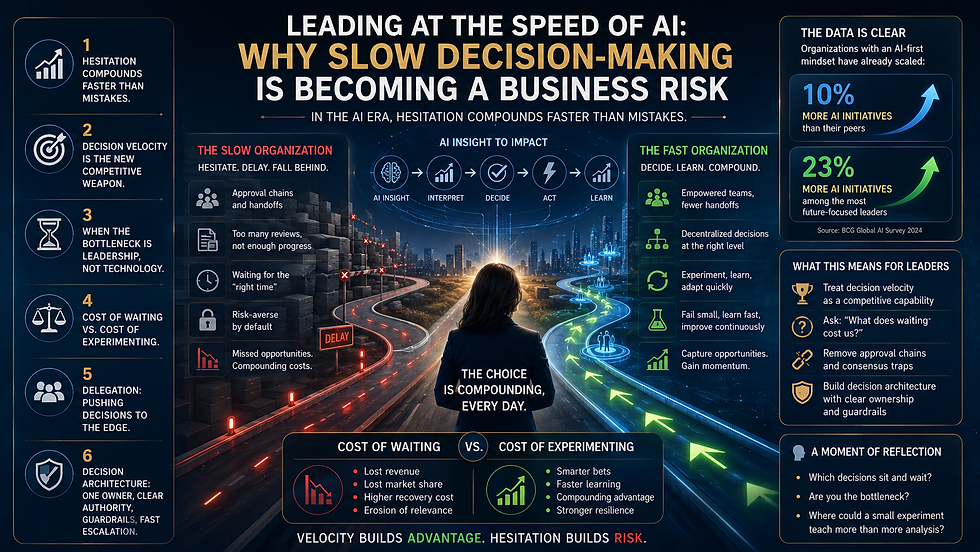
The question worth sitting with this week is not how fast can we move with AI. It is how ready are we to be accountable for what moves on our behalf. Speed without governance does not create transformation. It creates exposure that looks like progress until something breaks.
This week's edition is about that discipline: the leadership signal boards are now sending, the strategic reframe AI initiatives need, the operating model agents require before they scale, the skills bottleneck slowing all of it down, and the trust leaders must build before anyone adopts anything at all.
1. The Leadership Signal: AI Governance Readiness Is Now a Board-Level Question
Boards Are Asking a Different Question Than They Were Six Months Ago
An AI Leadership Forum convening public company directors and enterprise CEOs meets this month with one focus: oversight. Not whether AI works, but how fast the organization should move, where AI is creating value versus introducing risk, and what boards need from management to govern with confidence.
That shift matters. Harvard Business Review's research this year found senior leaders are struggling with AI adoption not because the tools underperform, but because the leadership capability required to govern them hasn't caught up. The executive challenge of 2026 is no longer proving AI works. It is proving you can be trusted to run it responsibly.
Agents are entering the software stack whether the underlying projects succeed or not. Most standalone agent initiatives will fail — not because the technology is weak, but because no one built the governance scaffolding around them before they went live. Boards have started to notice the difference between leaders who can explain their AI oversight model and leaders who are still improvising one.
Boards are no longer asking whether you understand AI. They are asking whether you can govern what you deploy — and that question is now reaching the board agenda before most leaders have an answer ready.
2. Leadership Lesson: Your Value Is Shifting From Answers to Judgment
I wrote recently about a question I hear often from senior leaders, usually asked quietly, after the meeting has ended: if AI can now do most of what I used to be valued for, what exactly am I still for?

It's a fair question, and it deserves a real answer rather than a reassuring one. AI is very good at producing options, drafts, summaries, and analysis at a speed no team can match. What it cannot do is decide which option matters, absorb the political and human context a decision sits inside, or take responsibility when the outcome is uncertain. That is still, entirely, the leader's job.
I think of leadership judgment less as a single skill and more as a discipline built through repetition: asking the sharper question before the obvious one, noticing what the data can't show you, and being willing to be the person who is accountable when the model is wrong. None of that shows up on a dashboard. All of it is becoming rarer, and more valuable, precisely because AI has made the easier layer of work abundant.
This week, I'd invite you to sit with three questions. Where in my role have I been rewarded for having answers, what the organization actually needs from me now is better questions? Where am I still doing work that AI could do as well or better, and what would I do with the time if I stopped? And when was the last time I made a call that no dashboard could have made for me?
The leaders who will hold their footing through this transition are not the ones racing to prove they can out-produce the tools. They are the ones building the judgment, discernment, and quiet confidence that no tool can substitute for. That is not a lesser kind of value. It may be the truest kind we have.
3. AI Strategy: Stop Measuring AI by Adoption. Start Measuring It by Governance Maturity.
Two-thirds of leaders still cannot point to a measurable productivity gain from their AI investment, and roughly one in four organizations have already paused or abandoned an AI deployment. That is not a sign AI doesn't work. It is a sign most AI strategies were built to measure the wrong thing.
Usage metrics — how many people logged in, how many prompts were run, how many pilots launched — measure activity. They don't measure whether AI created business value, and they don't tell a board whether the organization can be trusted to scale what it built. Seventy-four percent of organizations plan to adopt agentic AI within two years. Only 21% have a governance model mature enough to support that ambition.
The better approach treats AI strategy as an operating model question first and a technology question second. That means defining, for every initiative, five things before a single dollar is spent at scale: the risk and governance model, the data and platform readiness required, the use case's business priority, the skills the organization needs to run it, and the delivery discipline — security, monitoring, and MLOps — that lets it run safely once it's live.
For a CEO or CDO, the real strategic question is simpler than it sounds: who approves this AI use case, who monitors the risk it introduces, who owns the business outcome it's supposed to produce, and who is accountable when something goes wrong? If those four names aren't clear before an initiative launches, the initiative isn't ready — no matter how promising the pilot looked.
Key Questions Before You Scale Any AI Initiative
1. What business priority does this AI initiative support, specifically?
2. Who owns the value case outside the Data & AI team?
3. Who approves this use case, and who monitors the risk it introduces?
4. What does “working” look like in business terms, not technical terms?
5. What data and platform readiness does this require before it scales?
6. Who is accountable if this AI system produces a wrong or harmful outcome?
4. Agentic AI: Build the Operating Model Before Scaling the Agents
The gap between agentic AI enthusiasm and operational readiness is the defining story of 2026. Forty-one percent of enterprises are already running agentic AI in production. Only 15% say they're fully prepared to do so. Fivetran's Agentic AI Readiness Index found that gap is not a model-capability problem — it's a data, governance, and interoperability problem.
Eighty-two percent of leaders say AI only delivers real ROI when it understands how the business actually runs. Forty-five percent admit they cannot supply that context yet. Meanwhile, 84% of companies have not redesigned a single job around what AI agents can now do — they've simply layered agents on top of workflows built for humans, and then wondered why the results were uneven.
Before any organization scales an autonomous agent, leaders need answers to a short list of governance questions — not as paperwork, but as the operating model the agent runs inside. Access, escalation, and monitoring aren't constraints on agentic AI's value. They're the precondition for it.
Governance Design Questions Before You Deploy an Agent
1. What specific systems and data can this agent access, and what is explicitly off-limits?
2. Who is notified, and what happens, when the agent encounters a decision outside its authority?
3. Who owns the outcome if this agent acts and the result is wrong?
4. How do we monitor whether this agent is still doing what we originally designed it to do?
5. What is the escalation path when the agent's confidence is low or its action is high-stakes?
6. Have we redesigned the human role around this agent, or just added the agent on top of the old one?
7. What would it take for us to shut this agent off safely, quickly, and without disrupting the business?
5. Organizational Change: The AI Skills Gap Is a Leadership Issue, Not Just a Talent Issue
IDC projects that more than 90% of enterprises will face critical AI and data skills shortages this year, at a projected global cost of $5.5 trillion in delays and lost competitiveness. Demand for AI talent now outstrips supply by roughly 3.2 to 1. The real bottleneck in most organizations right now is not the technology. It's the workforce's ability to absorb it.
It's tempting to treat that as an HR problem — a hiring and training gap to be solved with budget. It isn't. Eighty-four percent of organizations haven't redesigned a single role around AI capability, which means most of the skills gap is self-inflicted: leaders are asking people to do new work inside old job descriptions, then wondering why adoption stalls.
Closing that gap starts with recognizing that an AI-driven organization needs two distinct kinds of capability, built deliberately, not left to chance.
Deep Specialists
AI engineers, data scientists, platform architects, and governance experts — the people who build, secure, and maintain the AI systems everyone else relies on. This group is scarce, in high demand, and worth investing in directly rather than hoping to backfill later.
AI-Augmented Generalists
Business leaders, analysts, project managers, and operations leaders who are fluent enough in AI to turn its output into real business decisions. This is the larger group, and it's where most organizations are underinvesting relative to the value it creates.
What Leaders Must Invest In to Build Both Groups
• AI literacy and hands-on fluency, not one-time training modules
• Role redesign that reflects what people actually do differently with AI in the loop
• Judgment and prompting skills — knowing what to ask for and how to evaluate what comes back
• Data fluency, so people can sense-check AI output rather than accept it blindly
• Change readiness — psychological safety to experiment, question, and admit what isn't working yet
6. Influence and Adoption: Move From AI Mandate to AI Belief
Ninety-seven percent of executives say they're personally benefiting from AI. Only 29% see significant organizational ROI. That gap is the clearest evidence that AI adoption is not primarily a rational decision. It's an emotional and organizational one, and most leadership communication about AI is still speaking to only one emotional driver: excitement.
Meanwhile, weak governance, unclear ownership, and outdated workflows are slowing adoption more than the technology itself. Employees experiment with new tools without integrating them into how work actually gets done, often because no one has removed the fear that experimenting will make their role redundant. You cannot mandate your way past that. You have to address it directly.
This is where ‘translator leadership’ matters most. The leaders who are actually moving adoption forward are not the loudest AI evangelists in the room. They are the ones who can stand between the technical capability and the people who have to live with it, and translate in both directions.
Translator Leadership: What You're Actually Translating
• Translate AI capability into business value people can actually see in their own work
• Translate technical risk into governance people can trust
• Translate fear into participation — invite people into the process instead of announcing it to them
• Translate ambiguity into a clear, honest answer about what changes for their role
• Translate early failures into learning, not blame
What builds organizational belief isn't a bigger rollout. It's consistency — leaders whose actions match their words, who admit what AI can't yet do as readily as they promote what it can, and who show up the same way in the tenth conversation about AI as they did in the first.
7. What Leaders Should Do This Week
Choose one AI initiative currently in motion in your organization. Ask these five questions before you let it move any faster.
1. Value: What business outcome are we actually trying to create — and would we recognize it if we saw it?
2. Ownership: Who owns the value case for this outside the Data & AI team?
3. Adoption: What behavior, decision, or workflow has to change for this to create real value — and who has agreed to change it?
4. Capability: Do the people involved have the skills, context, and confidence to use this well, or are we assuming they'll figure it out?
5. Trust: What governance, monitoring, and escalation paths are in place before we scale this further?
If you can't answer all five with confidence, that's not a failure. That's leadership information — a map of exactly where to focus before you scale.
AI Leadership Edge Reflection: What Should Leaders Do?
This week's throughline is simple to state and hard to practice: readiness, not speed, is what separates the organizations that will trust their AI systems from the ones that will spend the next two years cleaning up after them.
The signal from boards is that governance is now a leadership competency, not a compliance afterthought. The lesson is that your value as a leader is shifting from having answers to exercising judgment. The strategy question is not how fast can we adopt, but how well can we govern what we adopt. The agentic AI question is not can we deploy an agent, but have we built the operating model it needs to be trustworthy. And the skills gap slowing all of it down is, at its root, a leadership choice about what to invest in first.
None of this asks leaders to move slower for its own sake. It asks them to move with the kind of discipline that makes speed sustainable rather than reckless.
So what should leaders do? They should create the conditions where AI can become trusted, adopted, and valuable — one honest governance question, one redesigned role, one translated conversation at a time. That is the work. That is the edge.
Ready to Strengthen Your AI Leadership Edge?
IIf you are a Chief Data Officer, Chief AI Officer, SVP of Data & AI, or executive leader responsible for turning AI investment into real business value, this is the moment to strengthen your leadership operating system.
My Data & AI Leadership Winning Blueprint helps Data & AI leaders sharpen their vision, communicate strategy with influence, build stakeholder trust, and lead transformation with clarity.
My AI & Data Strategy Consulting Framework helps organizations move from scattered AI activity to a clear, governed, value-driven AI roadmap.
If your organization is investing in AI but struggling with adoption, governance, business alignment, or measurable ROI, I invite you to book a complimentary strategy conversation.
Together, we can move from AI excitement to AI maturity — and build transformation that lasts.
>> Reach out for a complimentary orientation on the program and embark on a transformative path to excellence.

May you grow to your fullest in your data science & AI!
Subscribe Grow to Your Fullest and
Get Your FREE data & AI Leadership Blueprint, or
Book a FREE strategy call with us
Learn more Data & AI strategy consulting framework


Comments