
AI Is Becoming Infrastructure: Long Context, Custom Silicon, and Why Energy Is the New Bottleneck

The Most Important AI Story of Late July 2026 Isn't a Model Launch. It's What Sits Beneath Every Model.
Data & AI Trends · August 2026
The headlines chase the models. But the story data and AI leaders should be watching in July 2026 sits quietly underneath them. AI is no longer a feature bolted onto business applications. It is becoming business infrastructure—as foundational as networks or electricity, and just as unglamorous. In the same window that Cisco was announcing agent fleets, three quieter shifts moved AI's plumbing forward at unusual speed: long-context models started reading whole codebases and contracts in one pass, Google split its custom silicon into distinct chips for inference (TPU 8i) and training (TPU 8t), and a new bottleneck emerged that has nothing to do with chips—energy. As one analysis put it plainly this month, "AI is becoming infrastructure for business, not a side tool for content tricks."
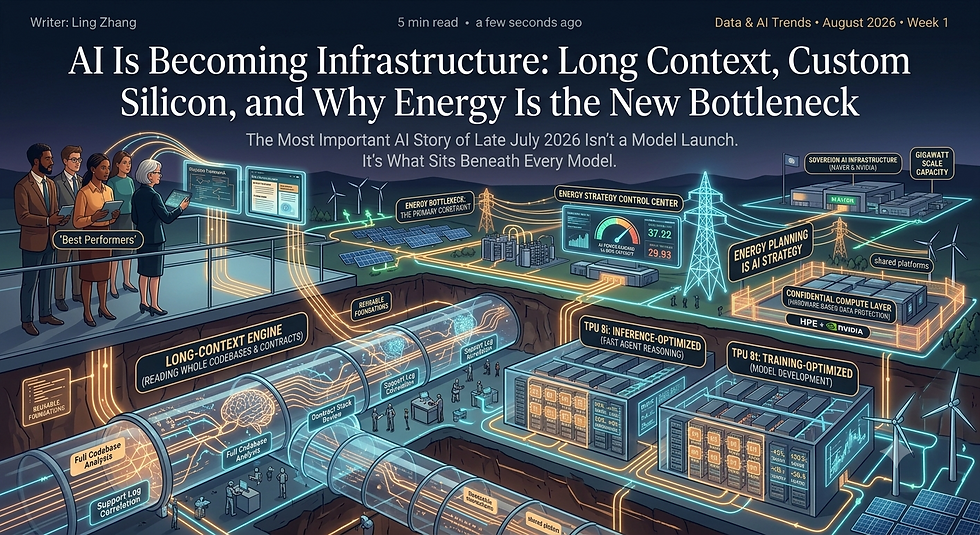
This is the story shaping how enterprises will build for the second half of 2026. Below the models, below the demos, the infrastructure layer that everything else depends on is getting rebuilt in real time.
AI Just Became Infrastructure
Oracle's July 2026 update captured the shift in one line: AI is turning into business infrastructure, giving faster research, safer software, lower compute costs, and better decisions—if built into real workflows. That "if" carries most of the weight. Treating AI as infrastructure changes what leaders invest in. Less in isolated point solutions. More in the shared platforms, data foundations, governance, and reusable components that the whole enterprise can build on. In the same way electricity mattered only when factories were redesigned around it, AI matters only when workflows are.
The Age of Long Context: Reading the Whole Codebase
Long-context models are quietly reshaping how enterprises actually use AI. When a model can read an entire codebase, a full stack of contracts, months of support logs, or a research library in one pass, work that used to require manual splitting and fragile chunking simply disappears. Fewer missed links across the business. Faster and safer software reviews. Local inference and security agents to keep private workloads private. The immediate implication for leaders: many of the retrieval-and-chunking pipelines built in 2024–2025 are already partially obsolete. It's worth asking which of your current AI systems assume short context and would be simpler—and stronger—if rebuilt around long-context capability.
Custom Silicon Is Bifurcating: TPU 8i vs. TPU 8t
July 2026 also saw Google introduce two purpose-built AI chips. TPU 8i is optimized for fast inference, tuned to power autonomous AI agents executing multi-step workflows. TPU 8t is designed for training complex models on a massive unified memory pool. The split matters. It signals that the era of general-purpose AI silicon is giving way to workload-specific hardware, where inference (real-time agent reasoning) and training (foundation-model development) have diverged enough to justify separate chip families. Meanwhile, TSMC reaffirmed strong multi-year demand for AI chips and its continued Arizona investment—a supply-side signal that the hardware layer is committing capital for years to come. For enterprises, the practical takeaway is that inference economics for agentic workloads are about to change fast, and 2026 architectural decisions will benefit from that.
The Confidential Compute Layer
As AI moves into sensitive workloads, trust in the compute itself becomes non-negotiable. HPE's integration of NVIDIA Confidential Computing for hardware-based data protection across the full-stack infrastructure quietly closes a gap most enterprises have been living with. Data that flows through an agent, a model, or a fine-tune increasingly needs to be provably protected end to end—including from the operator running the machine. Confidential computing is becoming a first-class layer of AI infrastructure, alongside compute, storage, and networking. Any regulated industry building on AI in 2026 should assume it will be expected soon, if it isn't already.
Sovereign AI Scales Up
Another quiet July signal: NAVER and NVIDIA announced expanded sovereign AI infrastructure on the NVIDIA DSX platform, starting at 55 megawatts with plans to scale to gigawatt capacity, supporting next-generation HyperCLOVA X models. The number that matters isn't the megawatt figure. It's what "gigawatt AI" implies. Sovereign AI is no longer a policy conversation. It is now being poured into concrete, cables, and cooling towers at national scale. Every multinational enterprise should assume that where AI computes will matter as much as how AI computes—and start planning around that reality now.
The New Bottleneck: Energy
Perhaps the most important trend of all in late July 2026 is what's now identified as the primary bottleneck for AI at scale. It is not chip availability. It is energy. As AI systems scale from pilots to production, and as agent fleets and long-context models raise the per-query workload dramatically, power has eclipsed silicon as the most critical constraint. Enterprises that assumed the limit on their AI ambition would be model capability or GPU allocation are quietly discovering that data center power delivery, cooling, and grid interconnects are becoming the real gate. For data and AI leaders, energy strategy has just become part of AI strategy. That is not hyperbole; it is arithmetic.
What This Means for Data & AI Leaders
For the week of August 3–7, five practical moves stand out:
Treat AI as infrastructure — invest in shared data, platforms, and governance the whole enterprise can build on, not one-off tools
Re-examine chunking pipelines — many long-context use cases will be simpler and stronger if redesigned around new model capabilities
Plan inference and training paths separately — the workload split now visible in silicon (TPU 8i vs 8t) will shape your cost curve for years
Add confidential computing to your AI architecture criteria — especially for regulated data
Make energy a board-level AI topic — power availability and efficiency are becoming the real constraint on AI ambition
A Moment of Reflection
Before the week begins, sit with these:
Are we designing AI as a feature, or as infrastructure the whole enterprise runs on?
How much of our AI stack still assumes short-context models—and what could be simplified if we rebuilt around long context?
Is our roadmap accounting for the fact that energy—not chips—may be our real constraint by year-end?
The most important AI story of late July 2026 isn't a model launch. It is the quiet, structural rewiring of what sits beneath every model—long-context capability, workload-specific silicon, confidential compute, sovereign-scale build-outs, and energy as the new bottleneck. The enterprises that see this layer clearly and design for it now will spend the second half of 2026 building durable AI capability. The ones who only watch the model headlines will keep bolting AI onto old plumbing—and quietly wonder why the results plateau. 🌊
Stay tuned for the next blog, and subscribe to the blog and our newsletter to receive the latest insights directly in your inbox. Together, let's make 2026 a year of innovation and success for your organization.
>> Discover the path to achieve sustainable growth with AI and navigate the challenges with confidence through our Data Science & AI Leadership Winning Blueprint that's tailored to help you craft a compelling data and AI vision and optimize your strategy—it's your key to success in the journey of Generative AI. Reach out for a complimentary orientation on the program and embark on a transformative path to excellence.

May you grow to your fullest in your data science & AI!
Subscribe Grow to Your Fullest and
Get Your FREE data & AI Leadership Blueprint, or
Book a FREE strategy call with us
Learn more Data & AI strategy consulting framework


Comments